
“Wonderful business. My counters and floors look awesome! Justin is professional and personable.”
Corian Countertop Repair in San Tan Valley and the East Valley
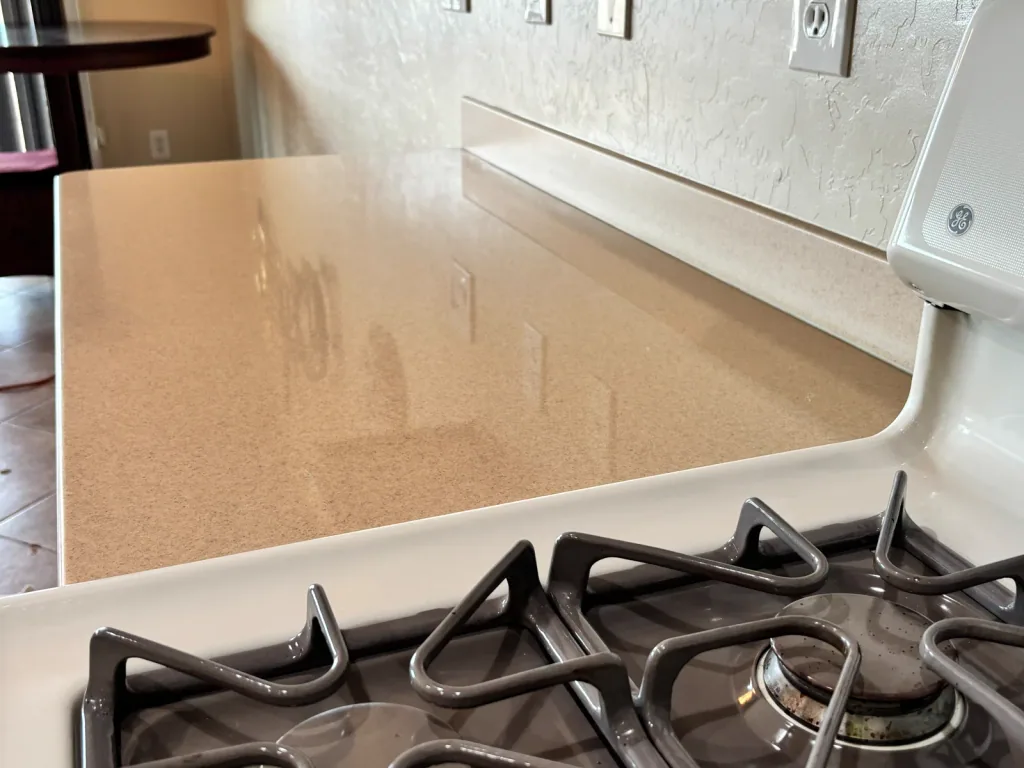
Corian is the good-news material on this site: because its color runs all the way through instead of sitting in a surface layer, most scratches, heat marks, and chemical clouding on a Corian solid surface countertop can be sanded and refinished back to factory condition. We diagnose what's actually happened before deciding whether it's a quick refinish or a structural repair.
Google Reviews
More than 100 reviews with a five-star rating.
“Wonderful service and the customer service is top notch! They got my floors spotless, which with 4 dogs is no easy task! Highly recommend!”
“AMAZING!!! Looks like I got brand new floors! Thank you. Would highly recommend”
“I highly recommend his floor cleaning services! He's reliable, professional, and does an excellent job. My floors looked amazing, and I couldn't be happier with the results.”
“Stain Wranglers are honest, reliable and trustworthy. They have impeccable work ethic and will treat you fairly. Please give them a try.”
“Outstanding customer service! So refreshing to use a company that carries very high standards. Stain Wranglers exceeded our expectations. A+”
“Highly recommend! On time, great service, and very professional. Very meticulous in their work.”
“When you meet someone, with character you know!! This is what my first impression was of Stain Wranglers, will use them over and over and spread the word to everyone. Thank you”
“Justin was quick to show up and get the job scheduled. He worked hard to get our home clean and followed up after he was done to make sure we were happy. Customer service at its finest! Highly recommended”
“Justin is super friendly and explains everything thoroughly. Def would recommend!”
What Corian actually is
“Corian” is a DuPont brand name, not a generic material, and precision matters here, because DuPont sells three different products under it. Corian Solid Surface is the acrylic-and-mineral material this page covers and what homeowners almost always mean by “Corian.” Corian Quartz is a separate engineered-stone product, and Corian Endura is a porcelain product; both have their own repair logic. Competing solid-surface brands like HI-MACS, Wilsonart Solid Surface, and Avonite are essentially the same material family.
Composition, confirmed against DuPont’s own technical bulletins, is roughly one-third acrylic resin (PMMA) and two-thirds mineral filler, primarily aluminum trihydrate from bauxite ore, plus pigment. At Mohs 2–3, it’s the softest material on this site, but fully non-porous. The detail that matters most for repair: color and composition run continuously through the entire thickness, not just a surface layer.
Why Corian develops problems in the first place
Because it’s acrylic-based rather than a fired ceramic or crystalline mineral, Corian’s failure modes come from everyday kitchen use hitting a relatively soft, heat-sensitive surface: knives, hot pans, and harsh solvents leave a mark more readily than on granite or quartz. The upside built into that same chemistry is what makes Corian different from everything else on this site, because it’s homogeneous all the way through, damage that would be permanent on a printed or coated surface can typically be sanded away and refinished, since there’s no separate finish layer to grind through.
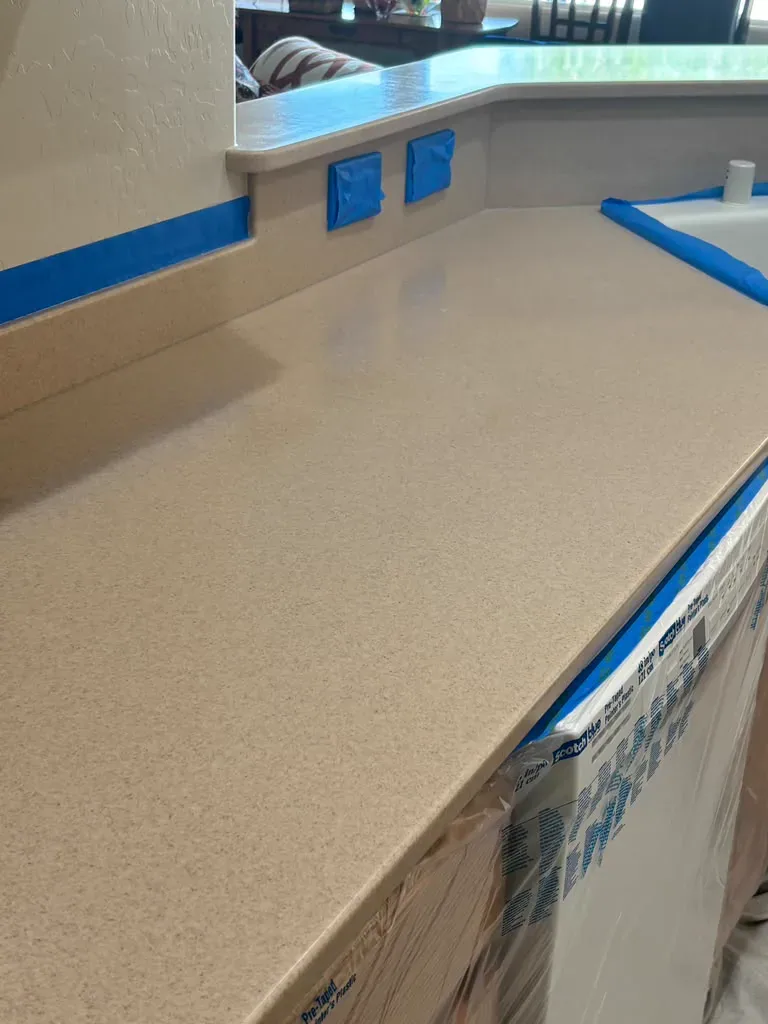
Common Corian countertop problems we see in the East Valley
- Fine scratches and uneven sheen, the most common complaint, from cutting directly on the surface, sliding cookware, abrasive scrubbers, or uneven spot-sanding from a prior DIY attempt.
- Heat marks and scorching, white rings, discoloration, roughness, or blistering from hot pans, air fryers, slow cookers, or instant-boiling-water taps.
- Cracks, from heat stress, square (rather than radiused) internal corners, failed seams, or cabinet and substrate movement.
- Seam failure, a visible dark line, a felt ridge, separation, or a crack extending outward from the seam.
- Hard-water film, a surface deposit only, since the material doesn’t absorb moisture.
- Chemical clouding, a white, milky haze from acetone, paint thinner, or oven cleaner softening the acrylic binder.
Residue, stain, etch, or damage?
- Residue or film, hard-water deposits or cleaning residue sitting on the surface. Because Corian is non-porous, this is the easiest condition to correct of any material on this site, a simple wipe-down resolves it.
- Stain, true absorbed staining essentially doesn’t happen on Corian given its zero porosity; what looks like a stain is more often chemical clouding (see below) or surface residue.
- Etch, does not apply. Corian has no calcium carbonate to react with acid, so it can’t etch the way marble or travertine does.
- Damage, the category that actually applies to Corian: scratches, heat marks, chemical clouding, cracks, and seam failure. All of these are physical or chemical changes to the surface itself, and nearly all of them are addressed the same way, sanding and refinishing.
How a professional diagnoses Corian
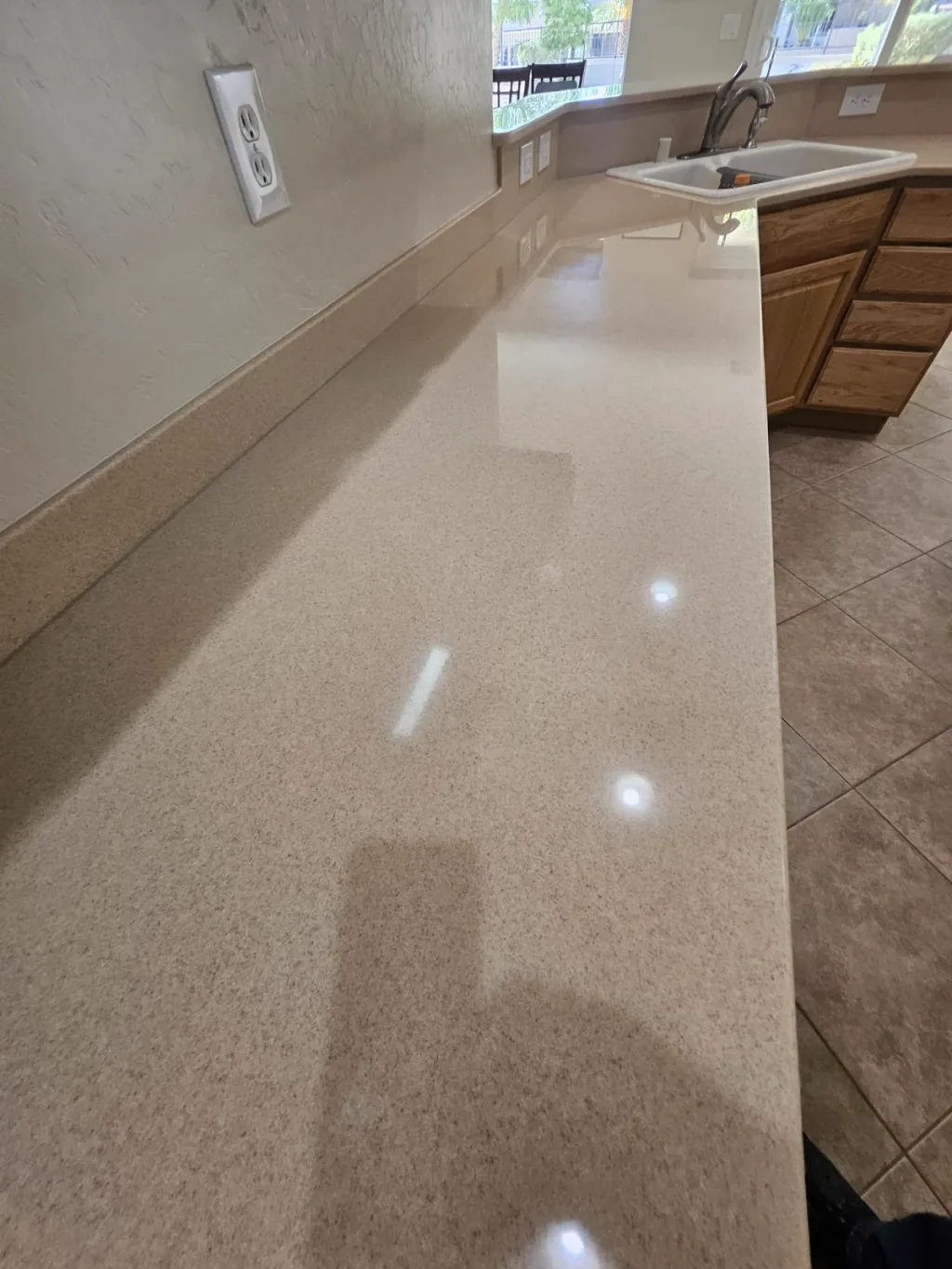
- Identify the actual product, confirm it’s Corian Solid Surface and not Corian Quartz, Corian Endura, or a competing brand, since repair approach differs by material.
- Document the symptom under raking light, note whether the mark is a scratch pattern, a heat ring, a crack radiating from a corner or cooktop, or a haze consistent with chemical exposure.
- Inspect the assembly, not just the surface, check cabinet/substrate movement, seam construction, and internal corner geometry (square corners concentrate stress more than radiused ones), since a structural cause needs addressing, not just the crack itself.
- Test conservatively, least-aggressive first, a light sanding test in an inconspicuous area confirms damage depth and sheen match before a full refinish.
Repair and restoration options
This is where Corian stands apart from every other material on this site: most scratches, heat marks, and chemical clouding can be sanded out and refinished to look factory-new, right on the countertop. The typical sequence is cleaning and degreasing, then a progressive sanding pass, coarse to fine, in wide overlapping strokes extending well beyond the damaged spot to avoid a visible dip, followed by sheen-matching. Matte and satin finishes are buffed with a conditioning pad; semi-gloss and high-gloss finishes need a finer abrasive progression plus a buffing compound.
Structural damage gets a different approach. Cracks are routed into a clean V-groove and filled with color-matched acrylic seam adhesive for narrow cracks, or a “dutchman” inlay strip for wider breaks, then sanded flush. Small chips and gouges can often be filled directly; larger ones may need a routed-out section with a matching insert.
What may not be repairable
Corian is genuinely the most repairable material on this site, but it isn’t limitless. Widespread heat damage across a large area, severe structural cracking that compromises a section of the countertop, or extensive water damage to the substrate underneath a compromised seam can push a repair past what sanding and refinishing can address, and section or full replacement becomes the more practical answer.
Corian and East Valley hard water
City of Phoenix water runs 172–302 ppm of hardness, or roughly 10–17.6 grains per gallon, per the city’s 2025 Water Quality Report. East Valley cities publish their own numbers, but they draw on the same Salt River Project and Colorado River supplies, and the water is hard across the valley. Because Corian is completely non-porous, that hard water is never absorbed into the material the way it would be with granite or marble, it’s a surface deposit only, making it the easiest of any countertop material here to correct. A wipe with warm soapy water and a thorough dry is usually all it takes.
Heat, sun, and monsoon considerations
Corian is more heat-sensitive than any other material on this site, which matters in a market where air fryers, slow cookers, and instant-boiling-water taps run constantly. DuPont’s own fabrication guidance calls for reinforced cutouts around heat-generating appliances specifically to reduce crack risk, worth confirming was done correctly at install. The desert’s intense sun and heat don’t degrade indoor Corian the way they degrade sealers on porous stone, since no sealer is involved, but consistent heat exposure near a sun-exposed window is still worth avoiding. During monsoon season (officially June 15 through September 30), the practical concern is the same as for any countertop: moisture reaching the substrate or cabinetry underneath through a compromised seam or cutout, not the material itself.
Daily care and prevention
- Clean with warm, soapy water in circular motions for even sheen; rinse and dry fully to prevent hard-water film from settling.
- Never pour boiling water directly into a Corian sink without cold water running at the same time.
- Use cutting boards and trivets even though the surface is repairable, prevention still beats repair.
- Avoid acetone, paint thinner, and oven cleaner, which can soften and cloud the acrylic binder.
- Never apply a stone sealer, it does nothing on a non-porous surface and can leave a sticky film.
- Avoid waxy window cleaners, which can dull the finish over time.
When to call a professional
Call a professional for any heat mark, deep scratch, crack, seam separation, or chemical cloudiness that doesn’t come out with normal cleaning. Because Corian can genuinely be restored to factory condition in most cases, it’s worth getting a proper assessment before assuming a mark is permanent or that the countertop needs replacing.
Common corian questions
Is Corian the same thing as Corian Quartz or Corian Endura?
No, and this trips up a lot of homeowners because they're all sold under the same DuPont brand. "Corian" by itself almost always refers to Corian Solid Surface, the acrylic-and-mineral material this page covers. Corian Quartz is a separate engineered-stone product with different repair rules, and Corian Endura is a porcelain product, also with different rules. There are also competing solid-surface brands, HI-MACS, Wilsonart Solid Surface, Avonite, that behave essentially the same way as Corian Solid Surface. If you're not sure which one you have, that's worth confirming before assuming this page's repair advice applies.
Is my Corian actually repairable, or does it need replacing?
In most cases, repairable. Because Corian Solid Surface has zero porosity and its color runs through the entire thickness rather than sitting in a printed or coated layer, most scratches, heat marks, stains, and chemical clouding can be sanded down and refinished to look like factory-new, something you generally can't say about porcelain or engineered quartz. Replacement becomes the more realistic answer mainly for severe structural cracking or widespread heat damage across a large area.
Can a scratch or heat mark on Corian really be made invisible?
Usually, yes. Because there's no separate finish layer, a technician can sand the damaged area with a progressive abrasive sequence, coarse to fine, in wide overlapping passes that extend well past the damaged spot to avoid leaving a visible dip, and then match the sheen to the surrounding surface. Matte and satin finishes are typically buffed back with a conditioning pad, while semi-gloss and high-gloss finishes need a finer abrasive progression plus a buffing compound to get the sheen to match.
What happens if I pour boiling water into a Corian sink?
DuPont specifically warns against this: pouring boiling water directly into a Corian sink without cold water running at the same time can damage the sink area. It's an easy habit to build, and cheap insurance against a repair you'd otherwise need.
Should I seal my Corian countertop?
No. Corian Solid Surface is completely non-porous, so a stone sealer has nothing to penetrate and does nothing useful. At best it leaves a sticky film you then have to clean off; at worst it makes the surface harder to maintain than if you'd left it alone.
Why do dark Corian colors show scratches more than light ones?
It's a visibility issue, not a durability difference. Heavily pigmented, dark colors show fine scratches and uneven sheen more readily than light or patterned colors, simply because the contrast between the scratch and the surrounding surface is more visible. If you're choosing a color for a high-use kitchen in a busy household, that's worth factoring in even though the material itself performs the same regardless of color.
Video responses from clients we've served across the East Valley.
Hear what our customers have to say once the work is finished. You can expect the same care and attention when you invite Stain Wranglers into your home or business.
Request an assessment.
Tell us about your surface and what you’re seeing. We’ll help you work out the next step for your home or commercial property.
- Stone, tile, floors and countertops
- Residential and commercial, San Tan Valley & the East Valley, AZ
- No charge to have us look at it
Having trouble with the form? Open it in a new tab.