
“Wonderful business. My counters and floors look awesome! Justin is professional and personable.”
Granite Countertop Repair in San Tan Valley and the East Valley
Granite countertops are one of the most forgiving countertops that you can purchase. However, this doesn't mean that granite countertops don't need repairs every once in a while. In the East Valley, we still see deep-seated oil stains, rust marks, chips, and cracks within granite countertops. Each of these services requires a special approach to restore the stone to its natural beauty. That's why Stain Wranglers is here to help restore your stone.
Google Reviews
More than 100 reviews with a five-star rating.
“Wonderful service and the customer service is top notch! They got my floors spotless, which with 4 dogs is no easy task! Highly recommend!”
“AMAZING!!! Looks like I got brand new floors! Thank you. Would highly recommend”
“I highly recommend his floor cleaning services! He's reliable, professional, and does an excellent job. My floors looked amazing, and I couldn't be happier with the results.”
“Stain Wranglers are honest, reliable and trustworthy. They have impeccable work ethic and will treat you fairly. Please give them a try.”
“Outstanding customer service! So refreshing to use a company that carries very high standards. Stain Wranglers exceeded our expectations. A+”
“Highly recommend! On time, great service, and very professional. Very meticulous in their work.”
“When you meet someone, with character you know!! This is what my first impression was of Stain Wranglers, will use them over and over and spread the word to everyone. Thank you”
“Justin was quick to show up and get the job scheduled. He worked hard to get our home clean and followed up after he was done to make sure we were happy. Customer service at its finest! Highly recommended”
“Justin is super friendly and explains everything thoroughly. Def would recommend!”
What granite actually is
Granite is an igneous rock, it formed from slowly cooling magma deep underground, which is why it has that visibly crystalline, speckled structure instead of a uniform color. That structure is mostly quartz, feldspar, and mica, interlocked into a dense matrix, sometimes with smaller amounts of biotite or hornblende giving it darker flecks. It’s a siliceous stone, meaning its chemistry is silicate-based rather than calcium-carbonate based, which is the single most important fact about how it behaves in a kitchen.
Granite runs roughly Mohs 6 to 7 in hardness, which puts it well above a steel knife blade and close to porcelain tile. Porosity, on the other hand, is genuinely variable, commonly somewhere between 0.1% and 1.2% depending on the quarry it came from. That range is why you’ll hear both “granite is basically indestructible” and “my granite stained” from two different homeowners, and both can be telling the truth about their particular slab.
Why granite develops problems in the first place
Because granite’s chemistry is silicate-based, it doesn’t react with the acids that dissolve marble, no fizzing, no dulling, no etching from a splash of wine or lemon juice under normal use. That’s the good news, and it’s real. But acid-resistant is not the same as stain-proof or damage-proof, and most of what actually goes wrong with granite in an East Valley kitchen traces back to one of two very different mechanisms.
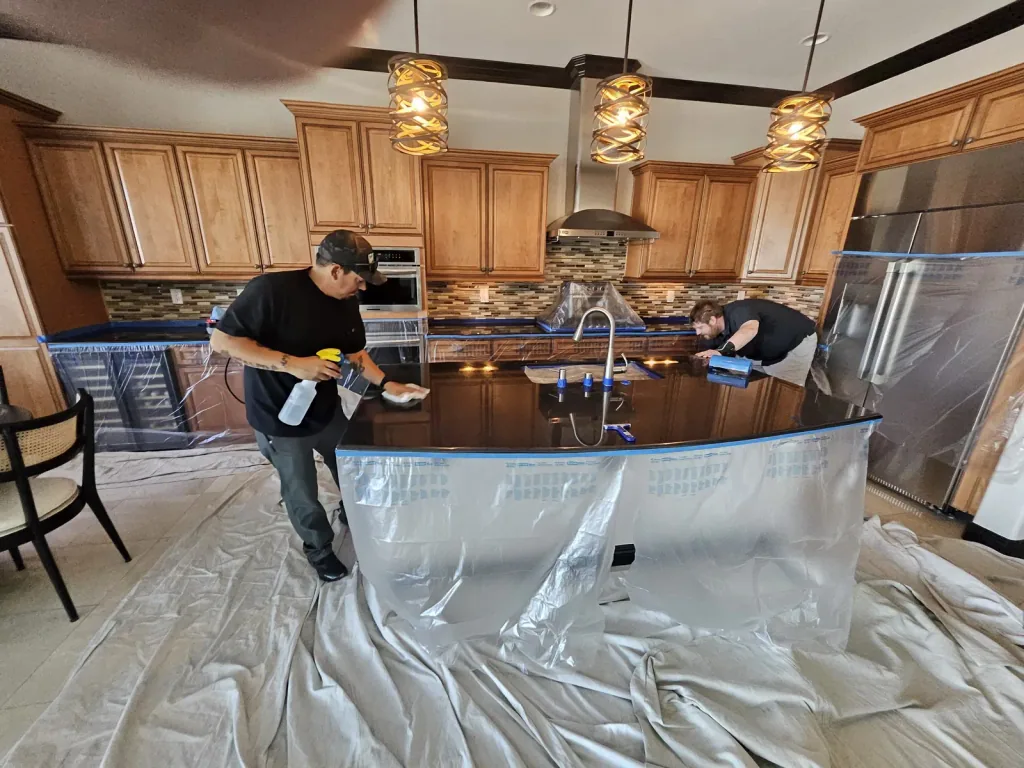
The first is porosity. Even a low-porosity slab has microscopic pore space, and oils in particular are small enough and persistent enough to work into that space near a cooktop or a cutting station, especially once the factory or reapplied sealer has started to wear thin. The second is mechanical stress, which has nothing to do with chemistry at all, chips and cracks in granite are overwhelmingly installation- and use-related: an unsupported overhang flexing under weight, a cabinet that wasn’t leveled correctly, an undermount sink pulling on its cutout without enough bracing, or years of someone setting hot pans and heavy objects down at the same spot near a corner.
Common granite countertop problems we see in the East Valley
- Oil and grease staining near cooktops, fryers, and prep zones, porosity-driven, not a chemical reaction
- Chips and cracks at stress points, sink cutouts, unsupported overhangs, corners, and areas with inadequate cabinet support
- Rust or iron staining where the stone’s own trace iron-bearing minerals react with standing water, or from a metal can or cast iron left wet on the surface
- Sealer failure showing up as increasing water absorption, especially on counters that get heavy sun exposure through a south- or west-facing window
- Etching-like marks that turn out not to be granite at all, some slabs sold as granite contain calcite veining or are a different, misidentified stone underneath a granite label
Residue, stain, etch, or damage?
Before any treatment gets chosen, we work out which of four things is actually happening, because they call for completely different responses.
- Residue or film sits on top of the stone rather than in it, think hard-water haze or a cloudy layer of built-up cleaner. It usually wipes or scrapes off with the right cleaner and doesn't mean anything is wrong with the granite itself.
- Stain means something has actually penetrated the pore structure. It reads as a darker, discolored patch with the surface texture unchanged, smooth to the touch, just off-color. This is the oil and rust category above, and it's the one that responds to poulticing.
- True etching is rare on granite because it's acid-tolerant, but if you see a dull, lighter, rough patch after acid contact, don't assume it's granite behaving normally, it may be a slab with calcite content that isn't pure granite, and it's worth having identified before you decide how to treat it.
- Damage is physical, a chip, a crack, an open seam, missing filler at a corner. This needs repair or stabilization, and the assembly underneath needs a look before anyone fills it cosmetically.
How a professional diagnoses granite
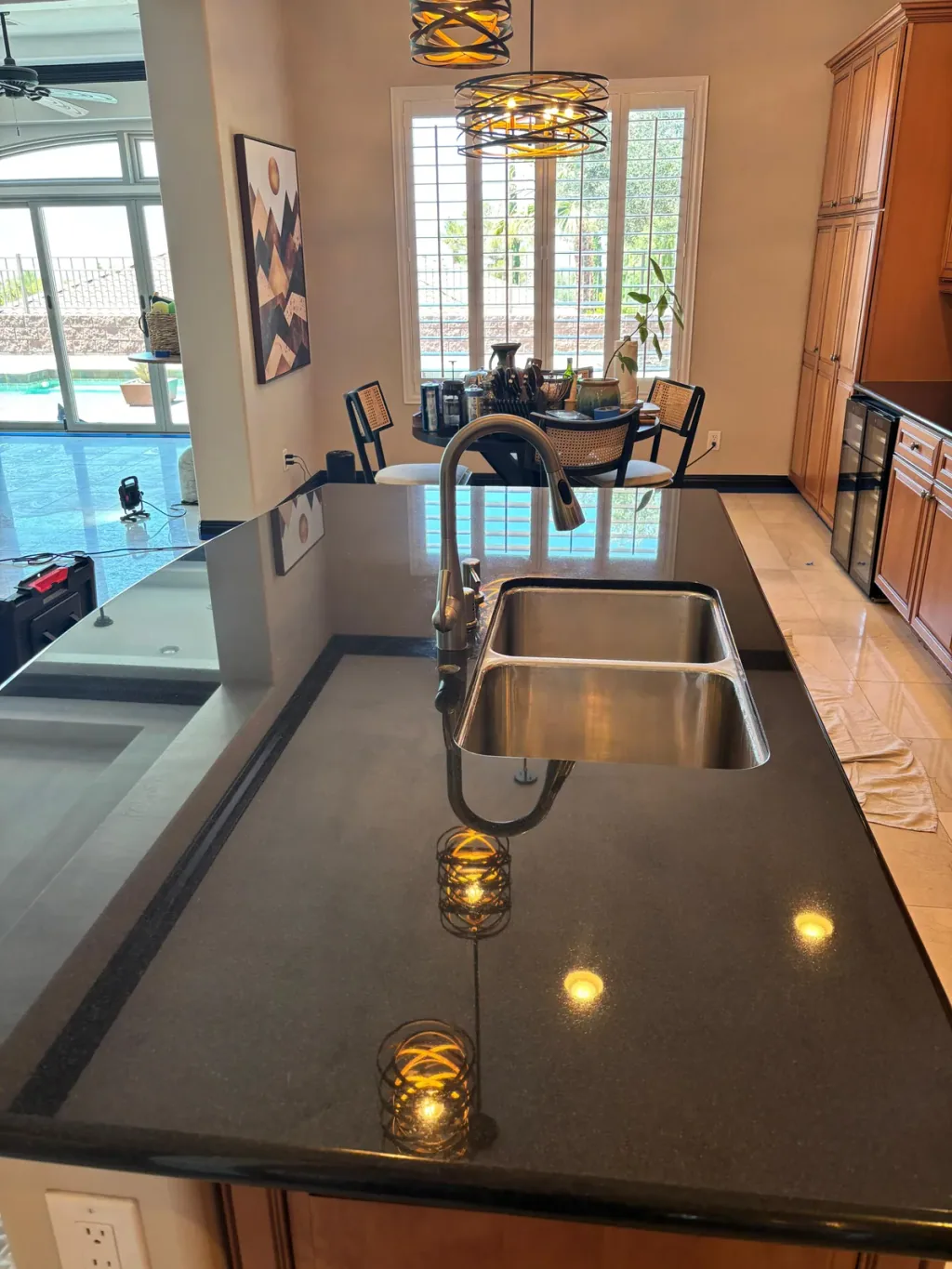
- Identify the material first. Confirm it's actually granite, not a mislabeled or blended stone, and note the finish (polished, honed, leathered) and sealer history, since all of that changes what treatment is appropriate.
- Document the symptom under raking light from a few angles. Does the mark disappear or darken when wet? Does it follow a seam or a mineral vein? Does it start at a stress point like a sink, cooktop, or corner?
- Inspect the assembly, not just the surface. For anything that looks like a crack, we check cabinet level, cutout support, and whether there's movement underneath before filling anything cosmetically, otherwise the repair just reopens.
- Test conservatively, least-aggressive first. Dry inspection, then a pH-neutral clean and reinspection, then a small test spot before any solvent, poultice, or abrasive touches a visible area.
Repair and restoration options
Most granite problems in East Valley kitchens are genuinely fixable:
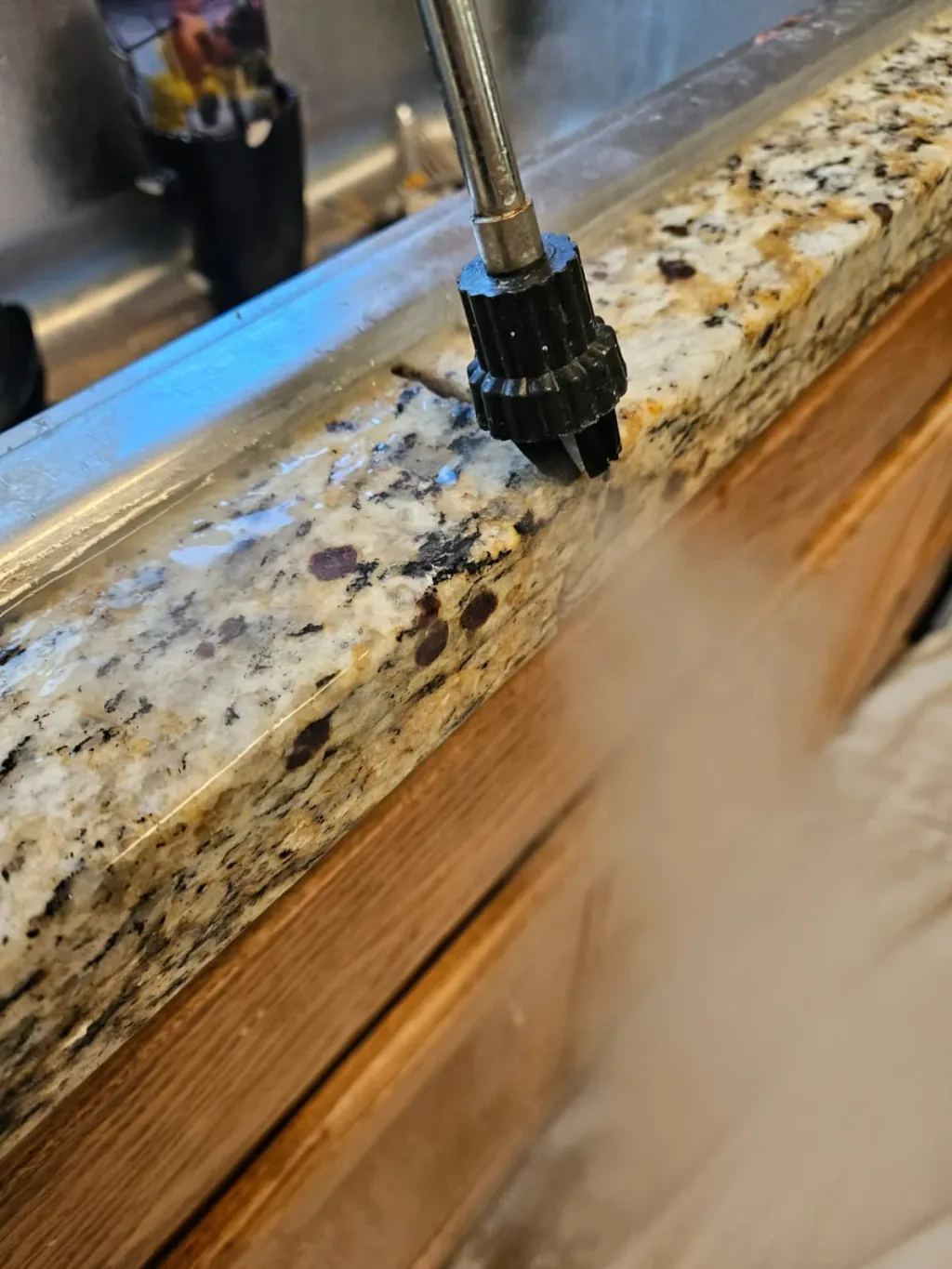
- Oil and grease stains, an absorbent clay poultice mixed with a solvent such as mineral spirits or acetone, applied over the stain, covered with plastic, and left 24 to 48 hours to draw the oil back out. Deeper or older stains sometimes need a second round. Our granite stain removal page covers oil, water, rust, and hard-water marks in more detail.
- Rust stains, a similar poultice approach using ammonium oxalate or a commercial iron-reducing product, since standard degreasers won't touch iron staining.
- Small chips, filled with a color-matched epoxy or acrylic resin, shaved flush to the surface. Cracks and open seams get the same treatment once the cause is dealt with; see granite chip, crack, and seam repair.
- Dull spots or light scratching, diamond-pad honing can restore the finish on the affected area. When the whole counter has lost its shine, granite countertop polishing starts by finding out whether it is worn or just coated.
- Sealer refresh, reapplied based on the water-drop absorption test rather than a fixed calendar, since sun exposure and usage vary counter to counter.
Before adding sealer or recommending polishing, we check whether residue is hiding the finish and whether the stone absorbs water. Our granite cleaning and sealing assessment explains that process and when cleaning alone may be enough.
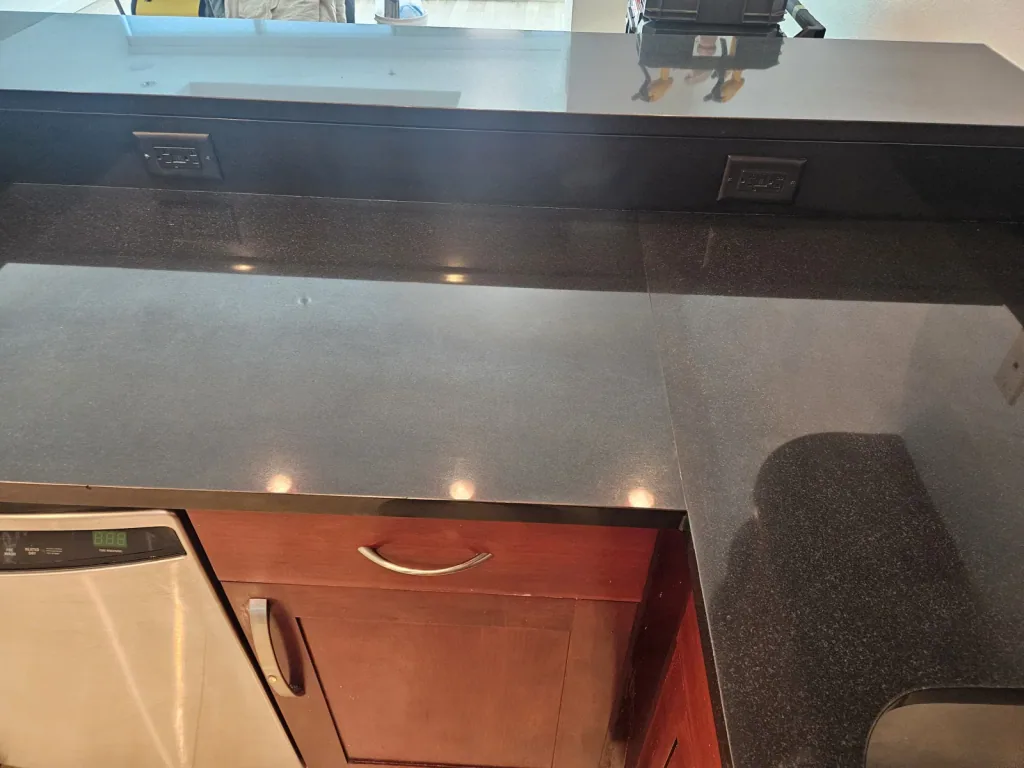
What may not be repairable
Be realistic about a few things. A crack that runs through the full thickness of the slab, especially one that traces back to a genuine structural issue like an unsupported overhang or a failed cabinet, may need more than cosmetic fill, the underlying support has to be corrected or the same crack (or a new one nearby) tends to come back. A very old, deep stain that has fully saturated the stone over years can sometimes lighten with poulticing rather than disappear completely. And if what looks like “granite” turns out on inspection to be a different, softer stone under a granite label, some of the repair assumptions in this article simply won’t apply to it, which is exactly why material identification comes first, not last.
Granite and East Valley hard water
City of Phoenix water runs 172–302 ppm of hardness, or roughly 10 to 17.6 grains per gallon, depending on where in the system your water comes from. East Valley cities publish their own numbers, but they draw on the same Salt River Project and Colorado River supplies, and the water is hard across the valley. On its own that’s not a threat to granite the way it is to more porous stones, but the desert climate changes how it behaves: because evaporation happens fast in dry desert air, the minerals in that hard water deposit on surfaces quickly and repeatedly rather than slowly, so a granite counter near a sink or coffee station can re-film with mineral haze within days of being cleaned. That’s a residue problem, not stone damage, and it wipes off, but it’s worth knowing so you don’t mistake water spotting for something wrong with the stone.
Heat, sun, and monsoon considerations
Granite tolerates heat far better than engineered surfaces, but a sealer doesn’t. On south- or west-facing counters that get long, direct desert sun, expect to check absorption more like every 6 to 12 months rather than annually, since intense UV and Arizona’s 100-plus days a year at or above 100°F accelerate sealer breakdown faster than a milder climate would. Thermal cycling, hot days, cooler nights, an air-conditioned interior against sun-heated stone near a window, can also contribute to hairline stress over years, which is one more reason a “crack” near a sunny window deserves a proper look rather than an assumption.
During the official Arizona monsoon window, June 15 through September 30, the bigger concern for an indoor granite counter usually isn’t humidity in the air, it’s a specific moisture path, like a roof leak, a window that isn’t sealing, or water working its way into an unprotected cutout edge near a sink. If you notice a change around monsoon season, look for a leak source before assuming the stone itself is reacting to weather.
Daily care and prevention
- Clean with a pH-neutral stone cleaner or mild soap and water, not vinegar, ammonia, bleach, or “natural” acidic cleaners
- Use trivets and cutting boards, granite is hard, but the sealer and finish aren’t
- Wipe up oil promptly rather than letting it sit near a cooktop or fryer
- Run the water-drop test occasionally, especially on sun-exposed counters, to know when to reseal
- Check sink caulk and seams periodically, since moisture intrusion there is a common early sign of trouble
When to call a professional
Call in a professional when a stain doesn’t respond to basic cleaning, when you’re unsure whether something is a fissure or a crack, when a chip or crack appears near a sink or cooktop cutout, or before you reseal a counter that’s been etched or damaged, sealing over an unresolved problem just locks it in place. A quick photo and a description of where the mark is and what happened near it is usually enough for us to tell you what you’re actually looking at.
Common granite questions
Is my granite cracked, or is that just a natural fissure?
Fissures are a normal part of granite's geology, a natural mineral separation that was already there when the stone was quarried, and they run parallel to the grain of the minerals around them. A crack is a later mechanical break. Cracks tend to cut across mineral grains rather than follow them, often catch a fingernail or show a slight change in elevation, and usually trace back to a stress point such as a sink cutout, a corner, or an unsupported overhang. If you're not sure which you're looking at, run a fingernail across it under raking light, if it catches or you can feel an edge, treat it as damage and have it inspected before it worsens.
Does granite actually stain, or is that overstated?
It genuinely can. Granite's low porosity makes it far more stain-resistant than marble or travertine, but porosity still varies quite a bit from one quarry lot to the next, and darker oils near a cooktop or a bottle of cooking oil left standing overnight can penetrate over time. "Granite doesn't stain" is closer to a marketing line than a fact, it stains less, not never.
Can I use vinegar or lemon juice to clean granite?
We don't recommend it as a habit. Granite is acid-tolerant compared to marble and won't etch from occasional contact with citrus or vinegar the way marble does, but repeated exposure degrades the sealer over time, which leaves the stone more open to staining down the road. Stick to a pH-neutral cleaner for daily use.
What actually damages granite chemically?
The real exception is hydrofluoric-acid-based products, some rust removers and certain toilet-bowl cleaners contain it, and it attacks silicate minerals, including the quartz and feldspar in granite. Keep those away from any stone countertop, including granite.
How do I know if my granite needs to be resealed?
Put a few drops of water on the surface in a spot you use often and watch it for 10 to 15 minutes. If the stone darkens noticeably in that window, water is absorbing into the pores and it's time to reseal. If it beads or stays put without darkening, the existing sealer is still doing its job, reseal on a schedule based on that test, not a blind annual calendar.
Can an oil stain or rust mark actually be removed from granite?
Most of the time, yes, with a poultice, an absorbent clay paste mixed with a solvent (mineral spirits or acetone for oil, ammonium oxalate or a commercial iron reducer for rust), applied over the stain, covered, and left for 24 to 48 hours so it pulls the stain back out as it dries. It sometimes takes more than one application on an older or deeper stain, but it's a legitimate fix, not a cosmetic cover-up.
Video responses from clients we've served across the East Valley.
Hear what our customers have to say once the work is finished. You can expect the same care and attention when you invite Stain Wranglers into your home or business.
Request an assessment.
Tell us about your surface and what you’re seeing. We’ll help you work out the next step for your home or commercial property.
- Stone, tile, floors and countertops
- Residential and commercial, San Tan Valley & the East Valley, AZ
- No charge to have us look at it
Having trouble with the form? Open it in a new tab.