
“Wonderful business. My counters and floors look awesome! Justin is professional and personable.”
Quartzite Countertop Repair in San Tan Valley and the East Valley
Quartzite is a very hard, generally acid-resistant natural stone, but the name gets used loosely at slab yards, and plenty of "quartzite" is actually a softer, calcareous stone. Before we treat anything, we confirm what's actually on your countertop. That check comes first in every quartzite countertop repair.
Google Reviews
More than 100 reviews with a five-star rating.
“Wonderful service and the customer service is top notch! They got my floors spotless, which with 4 dogs is no easy task! Highly recommend!”
“AMAZING!!! Looks like I got brand new floors! Thank you. Would highly recommend”
“I highly recommend his floor cleaning services! He's reliable, professional, and does an excellent job. My floors looked amazing, and I couldn't be happier with the results.”
“Stain Wranglers are honest, reliable and trustworthy. They have impeccable work ethic and will treat you fairly. Please give them a try.”
“Outstanding customer service! So refreshing to use a company that carries very high standards. Stain Wranglers exceeded our expectations. A+”
“Highly recommend! On time, great service, and very professional. Very meticulous in their work.”
“When you meet someone, with character you know!! This is what my first impression was of Stain Wranglers, will use them over and over and spread the word to everyone. Thank you”
“Justin was quick to show up and get the job scheduled. He worked hard to get our home clean and followed up after he was done to make sure we were happy. Customer service at its finest! Highly recommended”
“Justin is super friendly and explains everything thoroughly. Def would recommend!”
What quartzite actually is
Quartzite starts out as sandstone, a sedimentary rock made mostly of quartz sand grains, and turns into quartzite through heat and pressure over geologic time, the same kind of metamorphic process that turns limestone into marble, just starting from a different, silica-based parent rock. That heat and pressure fuse the sand grains together so thoroughly that the original grain boundaries essentially disappear, leaving a dense, crystalline stone that’s siliceous in chemistry, like granite, rather than calcareous, like marble.
That siliceous chemistry is the whole reason quartzite belongs in the granite family of behavior rather than the marble family, even though it’s often marketed and displayed alongside marble because of its similar veined look. Genuine quartzite typically runs around Mohs 7, generally at or above granite’s hardness, which makes it one of the toughest natural stone options available for a countertop.
Why quartzite develops problems in the first place
For a genuine, fully metamorphosed quartzite, the underlying mechanisms are close to what applies to granite: because the chemistry is silicate-based, it doesn’t react with the acids that etch marble, so acid contact isn’t the primary risk. What does vary considerably is porosity. Not all quartzite is created equal in how it formed, some varieties compressed into an extremely dense, low-porosity stone, while others remain considerably more porous and absorb liquids, including sealer itself, more readily. That range means the right maintenance schedule for one slab labeled “quartzite” can be quite different from another, even before mislabeling enters the picture.
The other major mechanism, and arguably the most common real-world source of quartzite complaints, isn’t chemistry at all, it’s a naming problem. “Quartzite” gets used commercially for slabs that are visually similar but not the same mineral, and a meaningful share of what’s sold as “soft quartzite” in slab yards turns out to be marble or a dolomitic marble instead. A stone that etches from lemon juice despite being labeled quartzite is very often just a mislabeled calcareous stone behaving exactly the way marble behaves, not quartzite failing to live up to its reputation.
Common quartzite countertop problems we see in the East Valley
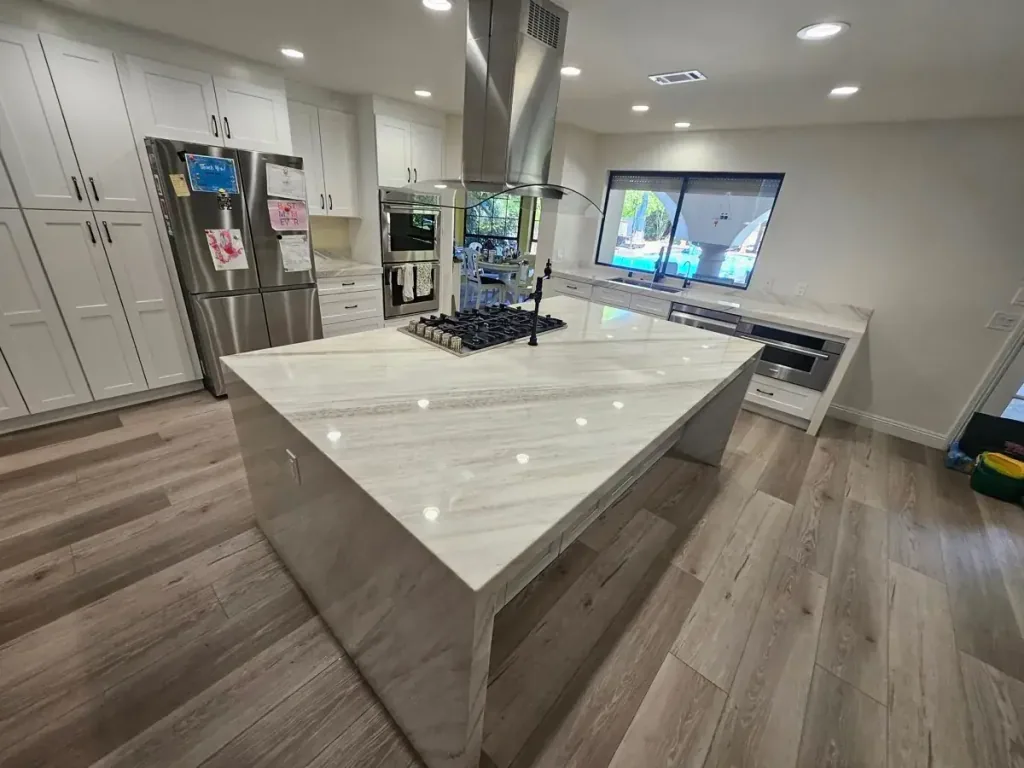
- Etching that shouldn’t happen on genuine quartzite, almost always traces back to a mislabeled, actually-calcareous slab rather than true quartzite failing
- Staining on more porous varieties, oil and other liquids can penetrate a higher-porosity quartzite much the way they would granite
- Chips and cracks at stress points, sink cutouts, unsupported overhangs, and corners, largely installation- and impact-related rather than a material defect
- Sealer wearing thin faster than expected on the more porous quartzite varieties, which need closer attention than a dense variety would
Residue, stain, etch, or damage?
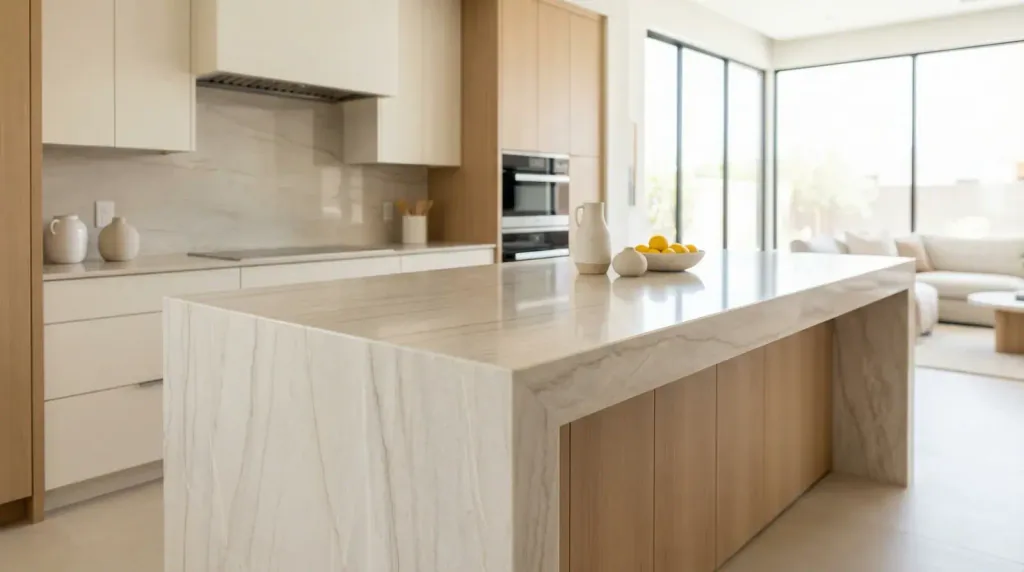
The same four-condition framework applies, with one added wrinkle specific to quartzite: confirming the material before deciding whether “etch” is even the right category.
- Residue or film sits on top, hard-water haze, cleaner buildup, and cleans off without any deeper treatment.
- Stain means something penetrated the pore structure, showing as a darker patch with the surface texture unchanged. This is realistic on a porous quartzite variety much the way it is on granite.
- A true etch on genuine quartzite would be unusual, so an apparent etch mark is the moment to stop and verify the material rather than proceed as if it’s a normal quartzite issue. If the stone reacted to an acidic spill, it’s worth confirming what the stone actually is before choosing a repair approach.
- Damage, chips, cracks, open seams, is physical and, as with granite, tends to trace back to installation or impact stress rather than the mineral itself.
How a professional diagnoses quartzite
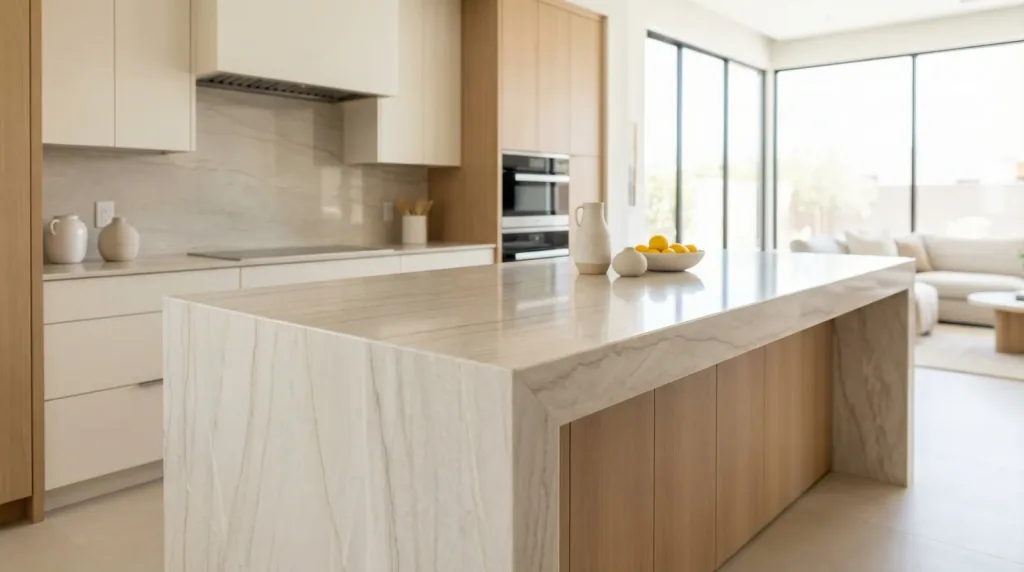
- Identify the material first, this step carries extra weight with quartzite. A simple inconspicuous-spot acid test tells us quickly whether we’re dealing with genuine siliceous quartzite or a mislabeled calcareous stone, and that answer changes everything downstream.
- Document the symptom under raking light, noting whether it darkens when wet (more consistent with staining) or looks dull and rough regardless (more consistent with an etch on a stone that turned out not to be quartzite).
- Inspect the assembly, not just the surface, for anything involving a chip or crack, cabinet support and cutout condition matter here exactly as they do for granite.
- Test conservatively, least-aggressive first, dry inspection, pH-neutral clean, reinspection, then a small test spot before any solvent, poultice, or abrasive touches a visible surface.
Repair and restoration options
Because genuine quartzite is a natural stone, its repair playbook closely mirrors granite’s:
- Stains, an absorbent poultice with an appropriate solvent, left 24 to 48 hours, drawing the stain back out of a porous variety
- Small chips, filled with a color-matched epoxy or acrylic resin, shaved flush
- Dull spots or light scratching, diamond-pad honing to restore the finish
- Sealer refresh, based on an absorption test specific to your slab, since porosity varies so widely across quartzite varieties
- If the stone turns out to be a mislabeled calcareous material, the marble repair approach applies instead, mechanical polishing or honing for an etch, since a poultice won’t fix that condition on any calcareous stone
What may not be repairable
A crack that runs through the full slab thickness and traces to a genuine structural issue underneath, an unsupported overhang, a settling cabinet, needs that underlying support addressed, or a cosmetic fill is likely to reopen. A very old, deep-set stain on a porous variety may lighten with poulticing rather than disappear entirely. And if what’s installed turns out to be a softer, mislabeled stone rather than true quartzite, some of the durability assumptions homeowners were sold at purchase simply won’t hold, which is a conversation worth having honestly rather than treating the stone as something it isn’t.
Quartzite and East Valley hard water
City of Phoenix water measures 172–302 ppm of hardness, roughly 10 to 17.6 grains per gallon. East Valley cities publish their own numbers, but they draw on the same Salt River Project and Colorado River supplies, and the water is hard across the valley. For a dense, low-porosity quartzite, that’s a surface residue issue much like it is for granite, mineral film that deposits quickly because the dry desert air makes water evaporate fast, and wipes off with normal cleaning. For a more porous quartzite variety, hard water can behave more like it would on a moderately absorbent stone, making periodic absorption testing and sealing more important than it would be on a dense slab.
Heat, sun, and monsoon considerations
Quartzite tolerates heat well as a natural stone, but as with granite, the sealer is the more vulnerable part of the system. On sun-exposed counters, especially south- or west-facing ones, the intense UV and sustained high heat accelerate sealer breakdown, so checking absorption more frequently than a blanket annual schedule makes sense here too. Thermal cycling between hot days and cooler nights can contribute to hairline stress over years, same as with any rigid natural stone.
During the June 15 to September 30 monsoon window, an indoor quartzite counter is generally more affected by a specific moisture-intrusion path, a roof or window leak, a failed seal around a cutout, than by ambient humidity itself. If you notice new staining or a change around monsoon season, it’s worth tracing the moisture source rather than assuming the stone itself changed.
Daily care and prevention
- Clean with a pH-neutral stone cleaner rather than acidic or abrasive products
- Use trivets and cutting boards, since even a hard stone’s finish can be marked with enough abrasive contact
- Run a water-drop absorption test periodically, especially if you’re unsure how porous your particular slab is
- Wipe up oil and other liquids promptly on any quartzite that tests as moderately porous
- If you’re ever unsure whether your counter is genuine quartzite, have it confirmed rather than assuming
When to call a professional
Call a professional if a supposedly acid-resistant “quartzite” counter etches, that’s the clearest sign worth investigating, since it usually points to a mislabeled slab rather than quartzite behaving unexpectedly. Also call for any chip or crack near a cutout, or before resealing over an unresolved mark. A photo of the affected area, along with what you know about the slab (where it was purchased, what it was sold as), helps us confirm what we’re actually working with before recommending a repair.
Common quartzite questions
My "quartzite" countertop etched from lemon juice, how, if quartzite is acid-resistant?
This is the single most common quartzite complaint, and the honest answer is usually that the slab isn't actually quartzite. The term gets applied loosely in slab yards to stones that look similar but behave very differently, and a fair amount of what's sold as "soft quartzite" is really marble or a dolomitic marble with quartzite-like veining. True, fully metamorphosed quartzite is siliceous and does not etch from kitchen acids the way marble does. If your counter etched, the most likely explanation isn't that quartzite failed, it's that the material wasn't genuine quartzite to begin with, and it's worth having it properly identified.
How can I tell if my countertop is real quartzite or mislabeled marble?
A basic acid-reaction check on an inconspicuous spot is the classic field test: a drop of vinegar or lemon juice left for a minute or two will visibly etch, dull, or fizz slightly on a calcareous stone like marble, but a genuine siliceous quartzite won't react at all. This isn't something to test on a visible area of your own counter, but a professional can confirm the material this way, along with a general look at hardness and how the stone takes a scratch test in an inconspicuous spot.
Does quartzite need to be sealed?
Often, yes, and the amount varies more than with granite. Some quartzite varieties are quite dense with very low porosity and need minimal sealing, while others are surprisingly porous and absorb sealer readily, needing more frequent attention. Because that range is wide even within genuine quartzite, we'd rather test your specific slab's absorption than assume a one-size answer.
Can quartzite be honed or repolished like granite?
Yes, since it's a genuine natural stone, quartzite responds to the same kind of diamond-pad honing and repolishing used on granite and marble. That's actually one of the practical advantages of confirming you have real quartzite rather than a mislabeled softer stone: the repair playbook that works on granite generally works here too.
Is quartzite more durable than granite?
Genuine quartzite is generally at least as hard as granite and often harder, since it starts as sandstone and gets further compressed and heat-altered during metamorphism. That said, "more durable" doesn't mean stain-proof or maintenance-free, porosity still varies by variety, and a porous quartzite can stain if it isn't sealed appropriately.
What causes chips or cracks in quartzite?
Much like granite, this is mostly installation- and stress-related rather than a material flaw, unsupported overhangs, inadequate cabinet leveling, cutout stress around a sink, or impact. It's worth having the support structure checked before a chip or crack gets filled, so the repair doesn't reopen.
Video responses from clients we've served across the East Valley.
Hear what our customers have to say once the work is finished. You can expect the same care and attention when you invite Stain Wranglers into your home or business.
Request an assessment.
Tell us about your surface and what you’re seeing. We’ll help you work out the next step for your home or commercial property.
- Stone, tile, floors and countertops
- Residential and commercial, San Tan Valley & the East Valley, AZ
- No charge to have us look at it
Having trouble with the form? Open it in a new tab.