
“Wonderful business. My counters and floors look awesome! Justin is professional and personable.”
Marble Countertop Restoration and Repair in San Tan Valley and the East Valley
Marble is the softest and most acid-sensitive of the common countertop stones, and most of what homeowners call "damage" is either a dull etch mark or an absorbed stain, two very different problems with two very different fixes. We identify which one you have before recommending anything. That diagnosis is the first step in marble countertop restoration and repair.
Google Reviews
More than 100 reviews with a five-star rating.
“Wonderful service and the customer service is top notch! They got my floors spotless, which with 4 dogs is no easy task! Highly recommend!”
“AMAZING!!! Looks like I got brand new floors! Thank you. Would highly recommend”
“I highly recommend his floor cleaning services! He's reliable, professional, and does an excellent job. My floors looked amazing, and I couldn't be happier with the results.”
“Stain Wranglers are honest, reliable and trustworthy. They have impeccable work ethic and will treat you fairly. Please give them a try.”
“Outstanding customer service! So refreshing to use a company that carries very high standards. Stain Wranglers exceeded our expectations. A+”
“Highly recommend! On time, great service, and very professional. Very meticulous in their work.”
“When you meet someone, with character you know!! This is what my first impression was of Stain Wranglers, will use them over and over and spread the word to everyone. Thank you”
“Justin was quick to show up and get the job scheduled. He worked hard to get our home clean and followed up after he was done to make sure we were happy. Customer service at its finest! Highly recommended”
“Justin is super friendly and explains everything thoroughly. Def would recommend!”
What marble actually is
Marble is a metamorphic rock formed when limestone gets subjected to heat and pressure deep in the earth, recrystallizing into the dense, often veined stone associated with countertops, floors, and monuments alike. Its primary mineral is calcite, calcium carbonate, sometimes mixed with dolomite. That composition puts marble in the calcareous category of stone, distinct from a siliceous stone like granite, and that one classification is the reason marble behaves so differently in a kitchen.
Marble is soft compared to the other common countertop stones, Mohs 3 to 4, versus granite’s 6 to 7, which means it scratches more easily and shows wear from foot traffic or heavy use faster than harder materials. Its calcite content is what gives marble its classic veining and its ability to take a deep, glossy polish. It’s also exactly what makes it vulnerable to acid.
Why marble develops problems in the first place
The mechanism is genuinely simple chemistry: calcium carbonate reacts with acid. CaCO₃ + 2H⁺ → Ca²⁺ + H₂O + CO₂. Any acid, lemon juice, vinegar, wine, tomato sauce, coffee, and plenty of “natural” cleaning products that market themselves as safe, dissolves a microscopic layer of calcite the moment it touches the stone, sometimes in under 30 seconds. What’s left behind is a spot where the polish no longer reflects light evenly: dull, slightly rough, lighter than the surrounding stone. That’s an etch, not a stain, and it’s a permanent surface change until it’s mechanically corrected.
This same chemistry is what weathers marble monuments and building facades outdoors over decades from acid rain, the U.S. Geological Survey’s own public explanation of that process describes calcite dissolving and surfaces roughening under acid exposure, which is the identical reaction happening on a countertop, just at kitchen-counter scale instead of monument scale. It’s worth knowing that your marble counter is reacting to acid by the same basic chemistry as a marble statue does, it just happens faster and more locally.
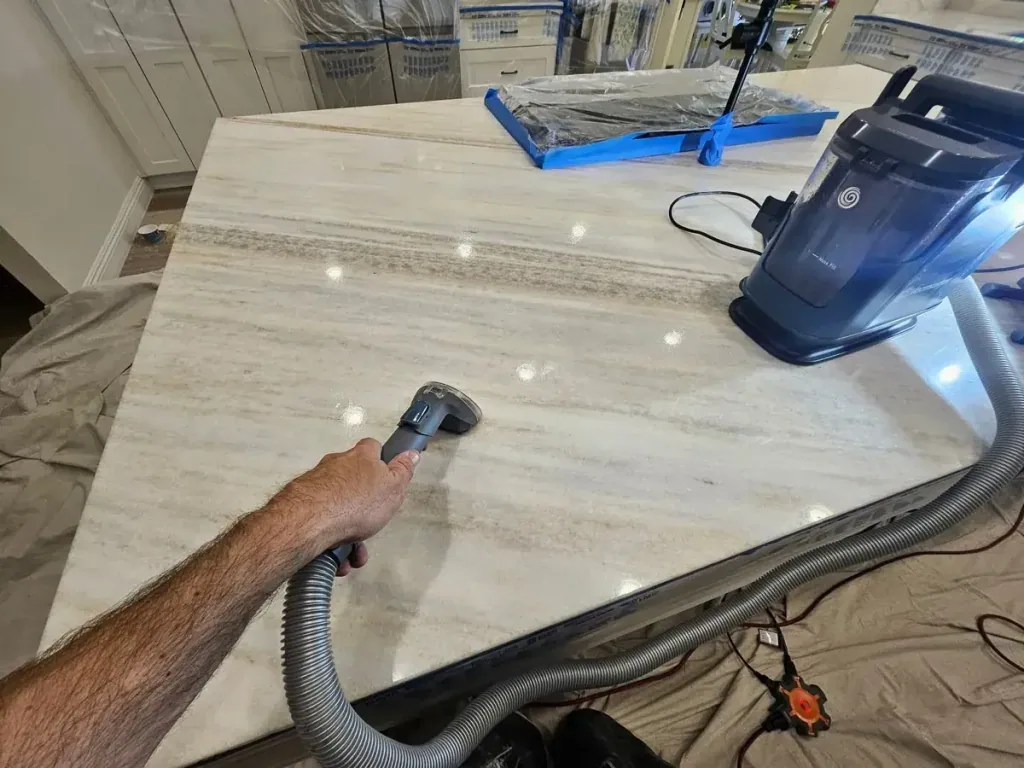
Common marble countertop problems we see in the East Valley
- Acid etching from citrus, wine, vinegar, tomato-based food, and coffee, the single most common marble complaint
- Staining from oil, which penetrates and darkens the stone, or water-based liquids, which tend to blur or lighten temporarily when wiped wet
- Scratching, since marble is soft enough to mark from knives, grit, or abrasive scrubbing
- General dulling from ordinary foot traffic or repeated light etching that accumulates without one obvious incident
- Yellowing, usually from trapped moisture reacting with trace iron in the stone, or from an improperly applied topical coating trapping moisture underneath rather than letting it breathe
Residue, stain, etch, or damage?
Marble is the one material in this framework where the etch category matters most, because it’s calcareous and reacts with acid in a way granite and quartz simply don’t.
- Residue or film is something sitting on the surface, not in it, hard-water haze near a faucet or built-up cleaner residue. It usually cleans off without any restoration work.
- Stain means a substance penetrated the stone’s pores. The field test: a stain reads darker than the surrounding marble, and the surface texture itself is unchanged and smooth.
- Etch is the calcareous-stone-specific condition, a chemical reaction, not absorption. It reads lighter, duller, or rougher than the surrounding polish, visible under raking light, and it’s the direct result of acid contact described above. No poultice and no chemical treatment fixes an etch, only mechanical polishing or honing does, because the damage is a change to the surface itself, not something sitting in the pores.
- Damage covers chips, cracks, and open seams, physical, not chemical, and it needs the assembly checked before any cosmetic fill.
For dull rings and splash marks, our marble countertop etch removal assessment explains how we evaluate the affected finish and decide between polishing and honing.
How a professional diagnoses marble
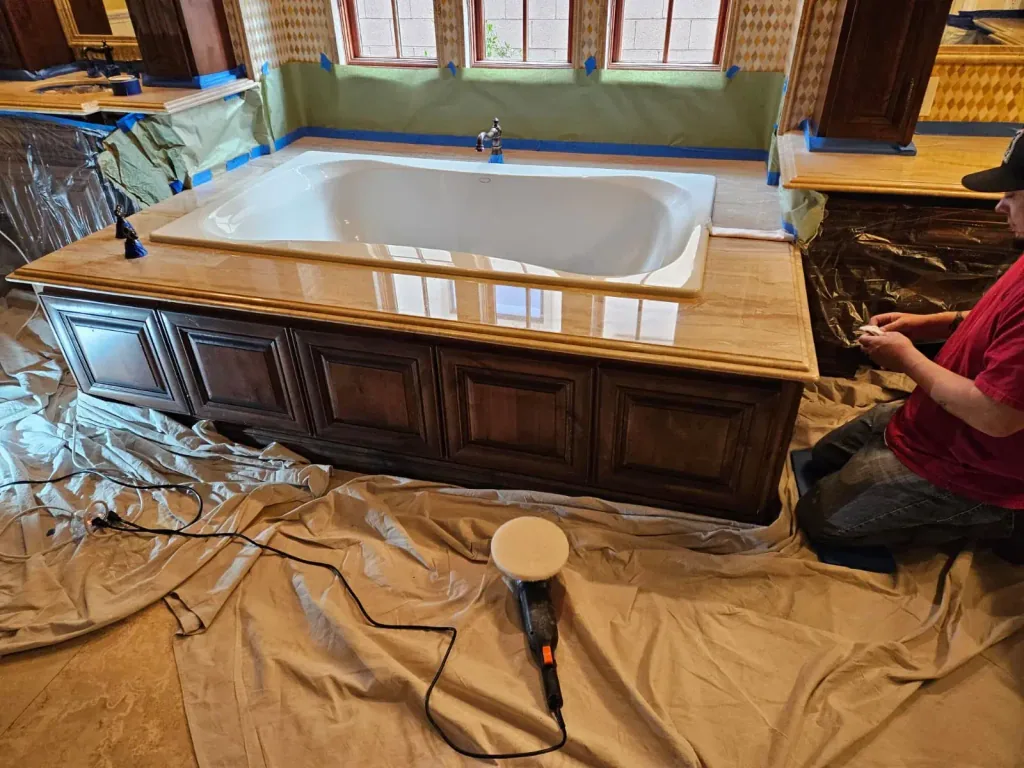
- Identify the material first. Confirm it’s actually marble rather than a marble-look quartzite, dolomite, or engineered product, since misidentification leads directly to the wrong treatment, a natural-stone diamond hone on the wrong material can do real damage.
- Document the symptom under raking light from multiple angles: does it darken when wet, or does it stay dull and rough regardless? Does it sit near a spot where acidic food or drink is prepped?
- Inspect the assembly for anything involving a chip, crack, or seam, cabinet support, moisture underneath, and cutout condition all matter before cosmetic repair begins.
- Test conservatively, least-aggressive first, dry inspection, pH-neutral clean, reinspection under raking light, then a small test area before any polishing compound or diamond pad touches a visible surface.
Repair and restoration options
- Light etching often responds to a marble polishing powder worked in by hand or with a low-speed buffing pad, restoring the reflective surface without removing much material.
- Moderate to severe etching needs diamond honing and repolishing, carried out 12 to 18 inches beyond the visible mark in every direction so the repaired area blends rather than leaving an optical dip where the sheen changes.
- Oil-based stains respond to an absorbent poultice pulling the oil back out over 24 to 48 hours; water-based staining is generally less stubborn and often improves with pH-neutral cleaning alone.
- Scratches are addressed the same way as light etching, honing the surrounding area to a consistent finish.
- Resealing on a schedule guided by absorption testing helps slow future staining, though as covered above, it does nothing for etching itself.
Cleaning and protection depend on what is on the surface and what has soaked into it. Our marble cleaning and sealing process explains how we assess residue, absorbed spills, and the need for sealer before treating the counter.
What may not be repairable
Deep or repeated etching over a very large area can require a full re-polish of the whole slab rather than a spot treatment, simply because feathering dozens of small repaired areas individually would leave an uneven, patchy sheen, at that point, redoing the whole surface is usually the better-looking and more cost-effective outcome. Old, deep-set stains that have fully saturated the stone over years may lighten with poulticing but not fully disappear. And if a “marble” counter is actually dolomitic marble or a different calcareous stone with unusual mineral structure, the standard honing approach may need adjustment, another reason material identification comes first.
Marble and East Valley hard water
City of Phoenix municipal water measures 172–302 ppm of hardness, roughly 10 to 17.6 grains per gallon. East Valley cities publish their own numbers, but they draw on the same Salt River Project and Colorado River supplies, and the water is hard across the valley. Because marble is porous, this matters more here than for a denser stone: the minerals in that hard water can be absorbed into the pore structure, not just deposited on top of it, and the dry desert climate means water evaporates fast, so mineral deposition happens quickly and repeats often. A counter around a sink or coffee station can develop a hazy film within days of being cleaned. That’s usually residue rather than staining, but on marble it’s worth wiping dry regularly rather than letting water sit and evaporate in place.
Heat, sun, and monsoon considerations
Marble’s sealer breaks down faster under the intense, near-constant desert sun than it would in a milder climate, which is why the standard 6-to-12-month resealing guideline should trend toward the shorter end here, sooner still on a counter that gets long daily direct sun through a south- or west-facing window. Thermal cycling between hot days and cooler nights can also contribute to hairline stress over time in a rigid stone like marble.
During the official Arizona monsoon window of June 15 through September 30, indoor marble is more affected by moisture-intrusion pathways than by humidity itself, a roof leak, a window seal failure, or water finding its way into an unprotected cutout edge near a sink. If yellowing or discoloration develops around monsoon season, it’s worth checking for a moisture source before assuming the stone reacted to weather on its own.
Daily care and prevention
- Use a pH-neutral cleaner exclusively, never vinegar, lemon-based products, or “natural” acidic cleaners, regardless of label claims
- Blot spills immediately rather than wiping, especially anything acidic
- Use cutting boards, trivets, and coasters as a matter of habit, not just for hot items
- Dry standing water around faucets and sinks promptly
- Reseal on the shorter end of the recommended interval given desert sun exposure
When to call a professional
Call a professional when you see a dull or rough spot that won’t respond to cleaning, that’s very likely an etch, and it needs mechanical correction, not a stronger cleaner. Also call before resealing over any visible stain or etch, since sealing locks in whatever condition is already there rather than fixing it. A photo taken in raking light, showing whether the mark is darker or lighter than the surrounding stone, is usually enough for us to tell you which problem you’re dealing with.
Common marble questions
Will sealing my marble stop it from etching?
No, and this is the single most common misunderstanding we run into. A penetrating sealer works inside the pores of the stone, slowing how fast liquids soak in, that's what helps prevent staining. Etching isn't absorption, though. It's a chemical reaction that happens right at the surface of the stone, where acid dissolves a microscopic layer of calcite on contact, often within seconds. That reaction happens above where the sealer sits, so sealer has no effect on it at all. If your sealed marble etched from a splash of wine or lemon juice, the sealer did exactly what it was supposed to do, it just was never designed to stop that particular problem.
Is this mark a stain or an etch?
Look at how it compares to the surrounding stone. A stain is darker than the area around it, because something soaked in and discolored the marble from within, the surface itself is still smooth. An etch is lighter, duller, or rougher than the surrounding polish, because the surface chemistry has actually changed, you can often feel a slight texture difference if you run a finger across it. Darker means stain, lighter and rougher means etch.
Can an etch mark be polished out myself?
Light etches sometimes respond to a marble polishing powder worked in by hand or with a low-speed pad, and that's a reasonable DIY attempt for a small, shallow mark. Moderate to severe etching needs diamond honing carried out well beyond the damaged spot, typically 12 to 18 inches past the mark in every direction, so the repaired area doesn't leave a visible dip or ring where the polish level changes. That feathering step is easy to get wrong without the right equipment, and a botched attempt usually makes the eventual professional repair larger, not smaller.
What can I use to clean marble safely?
A pH-neutral cleaner made for stone, or plain mild soap and water. Anything acidic, vinegar, lemon-based cleaners, most "natural" cleaning products, will etch marble on contact regardless of what the label promises. Blot spills rather than wiping them, since wiping can spread an acidic liquid across a wider area before you get to it.
Why does my marble look duller than when it was installed, even without an obvious spill?
General dulling from foot traffic, repeated light etching from everyday acidic contact you might not have noticed at the time, or aggressive scrubbing with the wrong cleaner all accumulate gradually rather than all at once. It's common for marble to lose its original sheen over a few years of normal kitchen use even without one memorable spill you can point to, that's honing and repolishing territory, not a single poultice fix.
Does the desert climate make marble worse, or is it mainly the acid exposure?
Both play a role, but differently. Acid exposure causes etching regardless of climate. What the desert adds is faster water evaporation, which means the hard water here deposits minerals on the surface more quickly and repeatedly, and it also means sealer breaks down faster under intense, near-constant desert sun, so marble here typically needs resealing on the shorter end of the normal range, or more often on a sun-exposed counter.
Video responses from clients we've served across the East Valley.
Hear what our customers have to say once the work is finished. You can expect the same care and attention when you invite Stain Wranglers into your home or business.
Request an assessment.
Tell us about your surface and what you’re seeing. We’ll help you work out the next step for your home or commercial property.
- Stone, tile, floors and countertops
- Residential and commercial, San Tan Valley & the East Valley, AZ
- No charge to have us look at it
Having trouble with the form? Open it in a new tab.