
“Wonderful business. My counters and floors look awesome! Justin is professional and personable.”
Porcelain Countertop Repair in San Tan Valley and the East Valley
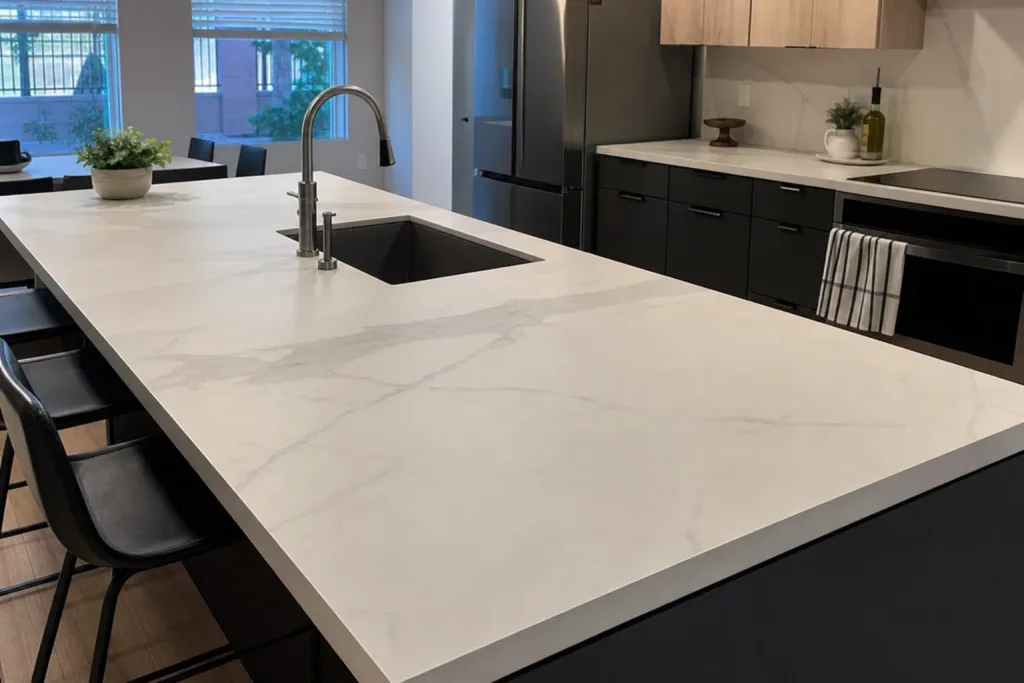
Porcelain slab countertops are marketed as nearly indestructible, and the face genuinely is extremely hard. What actually brings homeowners in San Tan Valley and the East Valley to call us is the edge, a chipped corner, a hairline seam crack, or a deep chip that exposes plain material under a printed pattern. We identify exactly what's damaged before recommending a fix. That diagnosis shapes every porcelain countertop repair we take on.
Google Reviews
More than 100 reviews with a five-star rating.
“Wonderful service and the customer service is top notch! They got my floors spotless, which with 4 dogs is no easy task! Highly recommend!”
“AMAZING!!! Looks like I got brand new floors! Thank you. Would highly recommend”
“I highly recommend his floor cleaning services! He's reliable, professional, and does an excellent job. My floors looked amazing, and I couldn't be happier with the results.”
“Stain Wranglers are honest, reliable and trustworthy. They have impeccable work ethic and will treat you fairly. Please give them a try.”
“Outstanding customer service! So refreshing to use a company that carries very high standards. Stain Wranglers exceeded our expectations. A+”
“Highly recommend! On time, great service, and very professional. Very meticulous in their work.”
“When you meet someone, with character you know!! This is what my first impression was of Stain Wranglers, will use them over and over and spread the word to everyone. Thank you”
“Justin was quick to show up and get the job scheduled. He worked hard to get our home clean and followed up after he was done to make sure we were happy. Customer service at its finest! Highly recommended”
“Justin is super friendly and explains everything thoroughly. Def would recommend!”
What porcelain actually is
Porcelain slab countertops aren’t natural stone at all, they’re the outlier on this site. Clay, quartz, and feldspar are fired at extreme temperature into a dense, largely vitrified slab. The industry-standard definition, set by ANSI A137.1 and tested under ASTM C373, is precise: a slab qualifies as porcelain when its water absorption, measured by a boil test, comes in at 0.5% or less. That threshold is the real line between porcelain and other ceramics, and it’s why porcelain behaves so differently from every stone material on this site. Face hardness runs Mohs 6–8, comparable to or exceeding granite and quartz, and standard slab thickness is 12mm.
Why porcelain develops problems in the first place
Because water absorption is near zero, porcelain doesn’t have the chemical vulnerabilities that drive problems in granite, marble, quartz, or travertine, it doesn’t stain from oil, doesn’t etch from acid, and never needs sealing. Its weak point is structural, not chemical. The face of a porcelain slab is fired hard enough to resist nearly everything a kitchen throws at it, but the thin, mitered edges and corners created during fabrication are comparatively brittle. A knock that wouldn’t mark the flat surface can chip a mitered edge cleanly, which is why “indestructible” marketing holds for the face but not the edges.
Common porcelain countertop problems we see in the East Valley
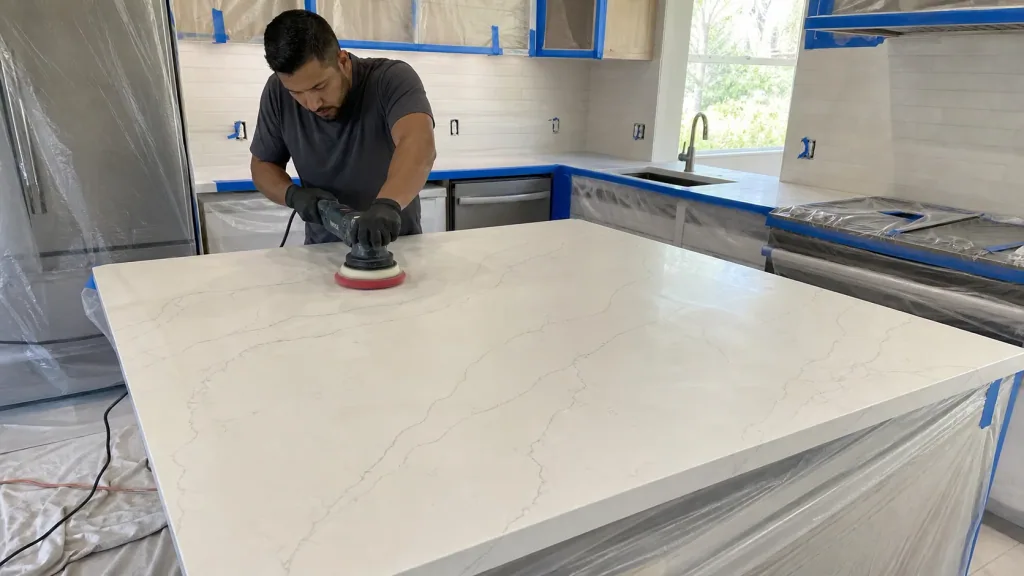
- Edge and corner chipping, the most common real-world complaint. A dropped pan or hard object striking a mitered edge or corner chips it, even from a relatively minor impact.
- Thermal shock cracking, rare, but a very hot pan meeting a cold slab, especially near a seam, can occasionally produce a stress crack.
- Printed-pattern exposure, a deep chip on a slab where the pattern is a surface print exposes the plain base-color body underneath, which looks nothing like the surrounding finish.
- Seam or cutout stress cracking, cracking that concentrates around sink or cooktop cutouts where support underneath was inadequate at install.
Residue, stain, etch, or damage?
Porcelain simplifies this framework considerably, since two of the four categories barely apply:
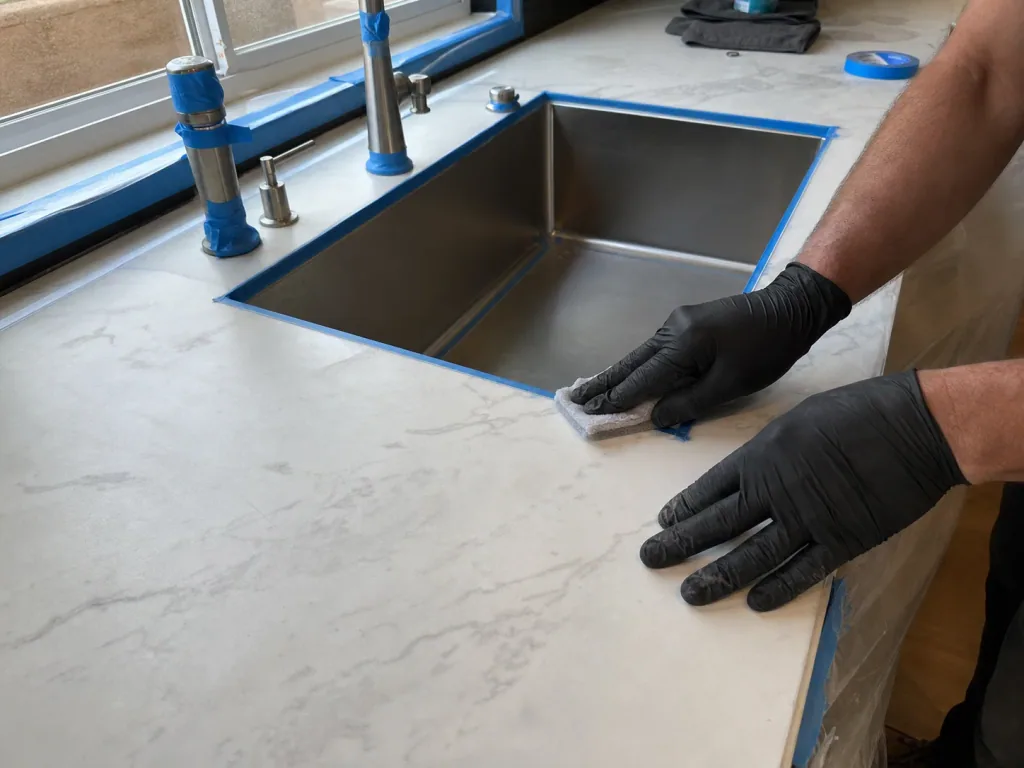
- Residue or film, the category porcelain issues fall into most often. Hard-water mineral deposits and cleaning residue sit entirely on the surface, since there’s no pore structure for them to soak into, and they wipe off with routine cleaning.
- Stain, genuinely rare on porcelain because of its near-zero absorption; something would have to sit on the surface long enough, or the surface would need to be damaged, for a substance to take hold.
- Etch, does not apply. Porcelain has no calcium carbonate to react with acid, so acidic spills that would etch marble or travertine have no chemical effect on porcelain.
- Damage, the category that matters. Chips, cracks, and edge fractures are physical, not chemical, and this is where an honest assessment of repairability comes in.
How a professional diagnoses porcelain
- Identify the actual product, confirm it’s genuine porcelain and whether the pattern is full-body or a surface print, since that changes what a chip repair can realistically achieve.
- Document the symptom under raking light, note whether damage is confined to an edge or corner, is a hairline crack near a seam, or correlates with a specific impact or thermal event.
- Inspect the assembly, not just the surface, check cutout support under sinks and cooktops, since cracks tracing back to inadequate support will recur if only the cosmetic damage is fixed.
- Test conservatively, least-aggressive first, confirm the extent of damage before committing to a fill, since porcelain offers no forgiving second attempt the way honing stone does.
Repair and restoration options
Edge and corner chips are porcelain’s most repairable damage: a color-matched epoxy fill restores the shape and, on textured or lightly patterned surfaces, can blend in reasonably well. On printed slabs, a skilled hand-painted touch-up over the epoxy can extend that blend to match the surrounding pattern lines, though it’s a cosmetic match rather than a true restoration of the original printed layer. Hairline seam issues can sometimes be addressed by re-sealing and re-supporting the joint if the crack hasn’t propagated into the body of the slab.
What may not be repairable
This is where we’re direct with clients rather than overpromising. A crack that runs through the body of the slab, or damage that crosses a printed vein or pattern line, generally cannot be made invisible, porcelain has no polish layer to restore the way honed stone does, and grinding into a printed surface permanently removes the pattern in that spot rather than revealing more of it underneath. In these cases, section or full slab replacement is the honest recommendation rather than a cosmetic repair that would look worse than the original damage.
Porcelain and East Valley hard water
City of Phoenix water measures 172–302 ppm of hardness, or roughly 10–17.6 grains per gallon, per the city’s 2025 Water Quality Report. East Valley cities publish their own numbers, but they draw on the same Salt River Project and Colorado River supplies, and the water is hard across the valley. Porcelain is the material on this site best equipped to handle it: because absorption is near zero, mineral deposits from evaporating hard water sit entirely on top of the surface rather than migrating into it. A wipe with a standard cleaner removes the film completely, with none of the etching risk that comes with using the wrong product on a calcareous stone.
Heat, sun, and monsoon considerations
Porcelain’s UV stability is a genuine advantage in the East Valley, where over 100 days a year reach 100°F or higher under intense, largely unfiltered sun, it doesn’t fade, chalk, or break down the way UV-sensitive resins can. Thermal shock cracking is uncommon but not impossible; a very hot pan set directly against a cold slab near a seam can occasionally produce a stress crack, so a trivet is still worthwhile. During and after monsoon season (officially June 15 through September 30), the main risk isn’t the material itself but moisture reaching unprotected cutout edges or compromised cabinetry underneath, worth a periodic check on outdoor and pool-adjacent installations.
Daily care and prevention
- Wipe clean with mild soap and water, no sealing is ever needed, and applying a stone sealer to porcelain does nothing useful.
- Use a cutting board; the face resists scratching well but there’s no reason to test it.
- Protect edges and corners from impact, use a trivet or pad when setting down heavy cookware near an edge.
- Confirm adequate support under sink and cooktop cutouts at install, since that’s where cracking risk concentrates.
- Use a hot pad for cookware straight off the stove, especially near seams.
When to call a professional
Call a professional for any chip at an edge or corner, a crack near a seam or cutout, or damage that has exposed the base material under a printed pattern. Porcelain’s repair options are genuinely more limited than materials like Corian, so getting an honest assessment early, repairable cosmetic fix versus section replacement, saves you from a repair attempt that won’t hold up or won’t blend.
Common porcelain questions
What actually makes a slab "porcelain"?
It isn't marketing language. Under the industry standard (ANSI A137.1, tested per ASTM C373 by boiling), a slab qualifies as porcelain when its water absorption is 0.5% or less. That near-zero absorption is also why porcelain is the only countertop material here that never needs sealing, there's essentially no pore structure for a sealer to protect.
Is porcelain really indestructible?
The face is extremely hard and holds up well to scratches, heat, and chemicals. But real-world damage on porcelain concentrates at the edges and corners, where thin, mitered joints are comparatively brittle. A dropped pan or a hard knock against a mitered edge can chip it even when the same impact wouldn't leave a mark on the flat surface. Treat the "indestructible" claim as true for the face and false for the edges.
Why does my chipped porcelain show white underneath instead of matching the surface?
It depends on how the slab was made. Many porcelain slabs carry their marble- or wood-look pattern as a high-definition print on roughly the top half-millimeter to one millimeter of the surface, rather than running the color through the full thickness. A deep chip on a printed slab exposes the plain base-color body underneath, which looks nothing like the surface pattern. Full-body slabs, where the pattern runs all the way through, don't have this problem, but you generally can't tell which type you have until damage happens, which is worth asking your fabricator at time of purchase.
Can a chip or crack in porcelain be polished out?
No, and this is worth being upfront about. Porcelain has no separate polish layer the way honed or polished natural stone does, so there's nothing to buff or repolish back to a like-new finish. Grinding a printed surface also permanently destroys the pattern in that spot. Small edge chips can sometimes be filled with color-matched epoxy, and on printed slabs the pattern can occasionally be hand-painted to blend, but a crack through the body, or damage that crosses a printed vein, usually means the section or slab needs replacing.
Is the white buildup on my porcelain countertop hard water or stone damage?
On porcelain, it's essentially always hard-water film. Because absorption is near zero, mineral deposits from the valley's hard water sit entirely on the surface and never soak in, which makes them one of the easiest things to clean off any material on this site, no risk of etching or staining the way you'd have with a calcareous stone.
Is porcelain a good choice for an outdoor kitchen in the Arizona sun?
Generally yes, porcelain's UV stability is one of its genuine advantages here. It doesn't fade or chalk under sustained sun exposure the way some sealers and resins do. The considerations that matter more outdoors are making sure edges are protected from impact and that cutouts around grills or sinks have adequate support, since that's where porcelain's cracking risk concentrates.
Video responses from clients we've served across the East Valley.
Hear what our customers have to say once the work is finished. You can expect the same care and attention when you invite Stain Wranglers into your home or business.
Request an assessment.
Tell us about your surface and what you’re seeing. We’ll help you work out the next step for your home or commercial property.
- Stone, tile, floors and countertops
- Residential and commercial, San Tan Valley & the East Valley, AZ
- No charge to have us look at it
Having trouble with the form? Open it in a new tab.