
Material
Natural travertine with its original variation
The floor had the movement, mineral character, texture, and natural voids that make travertine distinctive. Restoration needed to preserve those features rather than cover them with a coating.
Project proof · Ocotillo, Chandler, AZ
This residential Ocotillo project involved a natural travertine floor with dull areas, scratches, etching, and uneven wear. The homeowners wanted to repair the existing stone rather than replace it. This travertine floor restoration shows how we did it.
Stain Wranglers evaluated the surface, then restored it through cleaning, diamond honing, scratch and etch correction, detailed edge work, and a final finish matched to the home.
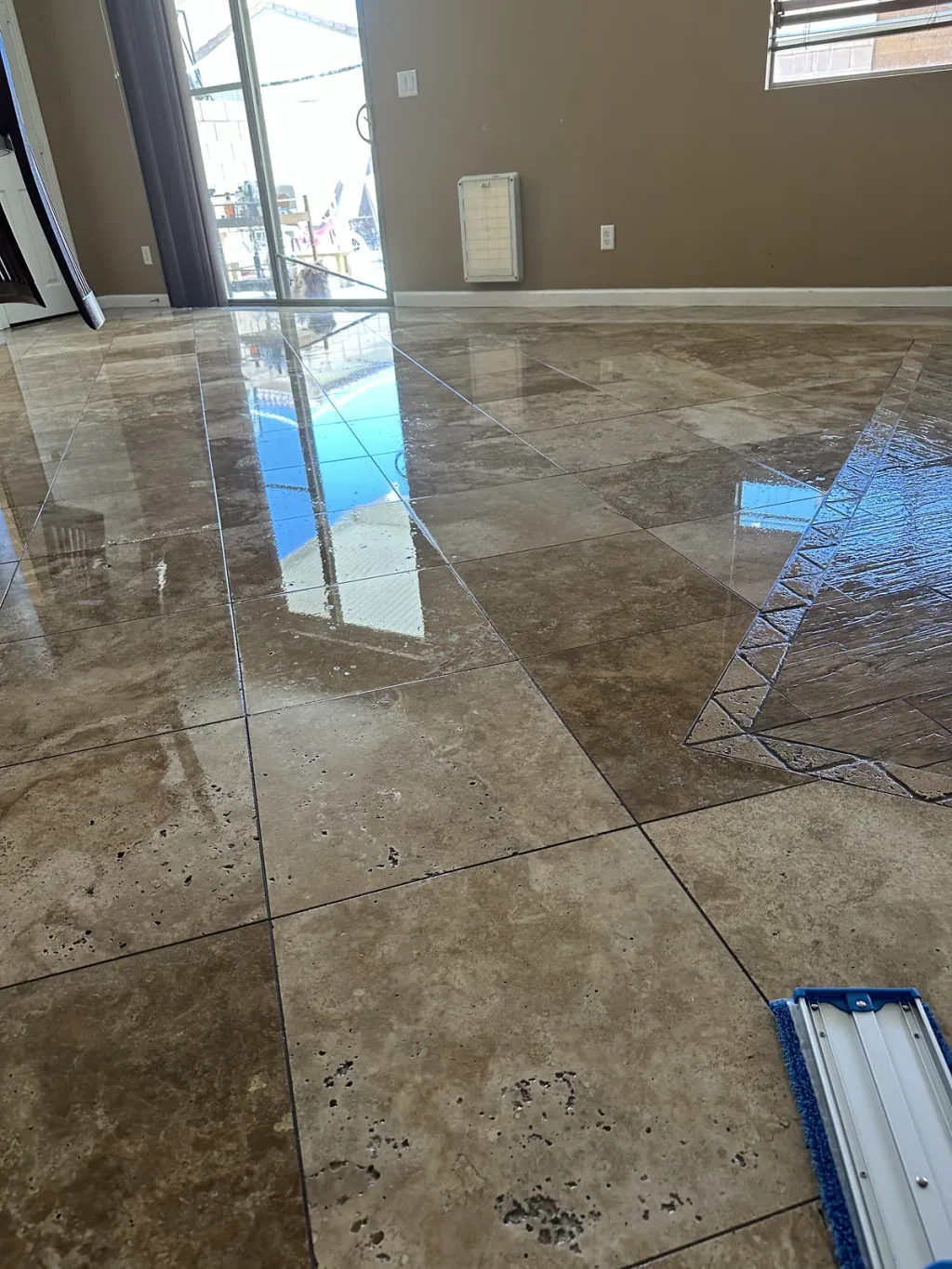
Routine cleaning could not correct the condition because the worn areas and etch marks affected the surface of the stone itself.
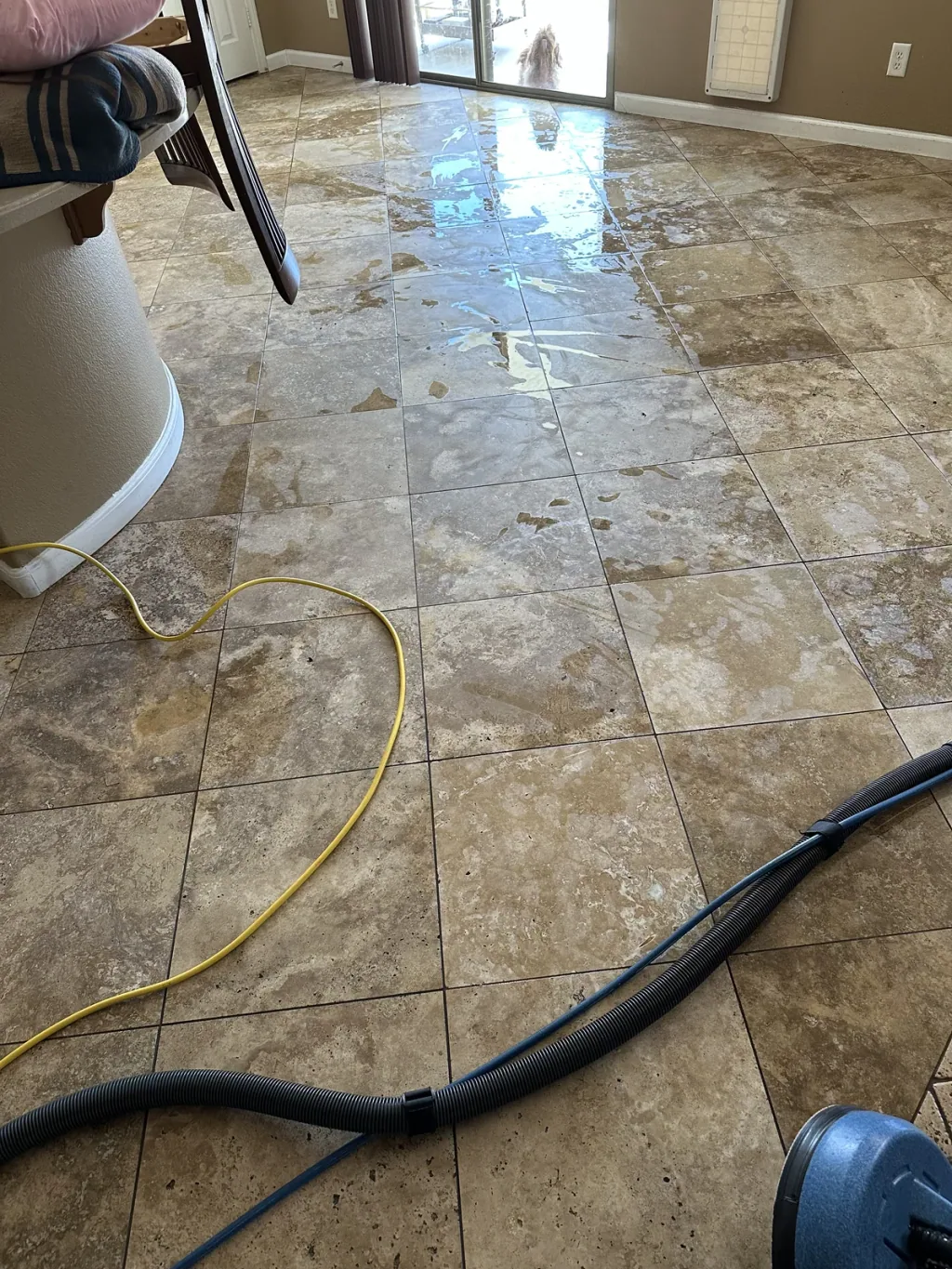
The homeowners were seeing dull areas, visible scratches, etching, and uneven wear across the installation. Some parts of the floor retained more of their original finish while the most-used areas had become noticeably worn.
Travertine is a calcium-based natural stone. When an acidic substance etches it, the result is physical change to the finish—not soil that a stronger cleaner can simply wash away. The restoration therefore had to address the stone surface, not just the appearance of the floor after mopping.
The recommendation was based on the material, the visible wear, and the finish the homeowners wanted—not on a one-size-fits-all floor treatment.
Material
The floor had the movement, mineral character, texture, and natural voids that make travertine distinctive. Restoration needed to preserve those features rather than cover them with a coating.
Condition
The visible dullness was not one problem. The floor needed the surface refined so the damaged areas would not remain underneath a new finish.
Decision
The plan focused on correcting the existing travertine with wet diamond abrasives, detail work, and progressive finishing rather than relying on wax or a topical coating.
Each stage had a purpose: protect the home, prepare the stone, correct the surface, and inspect the finish before the project was considered complete.
The travertine and areas needing correction were identified while baseboards, cabinets, walls, and adjacent finishes were protected.
Soil and residue were removed so the surface condition could be addressed directly rather than hidden beneath the restoration work.
Wet diamond stages mechanically refined the travertine and reduced the scratches, etching, dullness, and uneven wear.
Tight areas that larger equipment could not adequately reach received additional hand and edge attention for a more consistent floor.
The stone was brought to the desired finish, cleaned thoroughly, and checked as a completed surface.
The finished work brought the floor back to a more consistent appearance while keeping the natural color movement and character of the stone visible.
The dull and worn appearance was substantially improved, visible scratches and etching were removed or significantly reduced, and the finish became more consistent from area to area.
Because the work corrected the existing surface, the homeowners could keep the original natural-stone installation instead of removing and replacing a large amount of travertine. The remaining variation in color and movement is part of the stone—not a defect to hide.
A floor can look improved in its open center and still feel unfinished around the places that equipment cannot reach.
Edges, corners, transitions, areas around cabinetry, and other tight spaces require more than a pass through the middle of the room. Those areas were included in the restoration so the finished surface would read more consistently across the home.
This is also why the recommendation cannot be based on shine alone. Loose filler, open voids, lippage, cracked grout, previous treatments, and the depth of the wear all change the work required before the final finish is set.
Honing addresses damage in the stone instead of covering it.
Variation and original travertine voids remain part of the finished floor.
Edges and corners receive attention so the room does not stop at the machine's reach.
This Ocotillo job shows how travertine restoration combines diagnosis, honing, polishing, scratch correction, etch reduction, and detail work.
Completed service
Natural-stone restoration for dull, scratched, etched, or uneven travertine floors when the existing installation is a candidate for mechanical correction.
The project was completed in the Ocotillo area of Chandler, Arizona, on an existing natural-stone floor the homeowners wanted to preserve.
The right next step for another Chandler-area travertine floor is an assessment of the actual material, finish, damage, and access. A photo can help identify whether the concern looks more like soil, etching, worn finish, open filler, or a condition that needs another repair before polishing.
If your floor has a similar problem, call or text a photo. Stain Wranglers can explain what appears restorable and which finish makes sense before the work begins.
Have a similar travertine floor?
Tell us about your surface and what you’re seeing. We’ll help you work out the next step for your home or commercial property.
Having trouble with the form? Open it in a new tab.