
“Wonderful business. My counters and floors look awesome! Justin is professional and personable.”
Travertine Countertop Repair in San Tan Valley and the East Valley
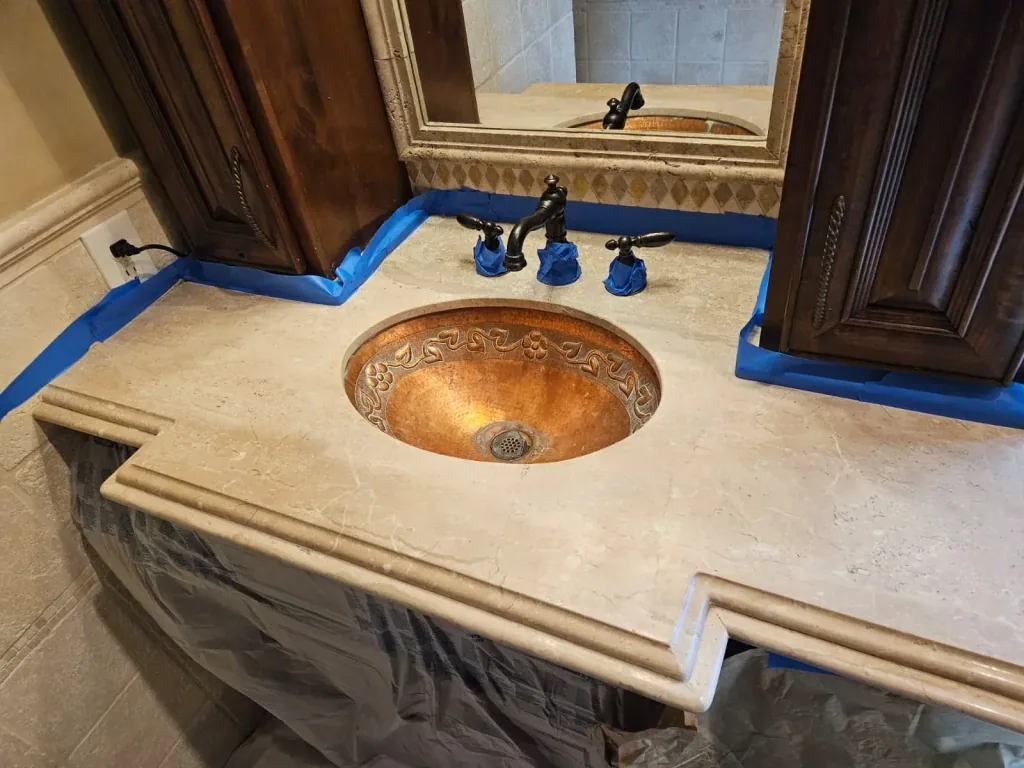
Travertine is the most porous stone we work on in San Tan Valley and the East Valley, and it shows in the calls we get: filler falling out of old holes, new voids opening up, and dull etch marks from cleaners that were never safe for it. We start every job by identifying exactly what happened before we touch anything. That is how every travertine countertop repair begins.
Google Reviews
More than 100 reviews with a five-star rating.
“Wonderful service and the customer service is top notch! They got my floors spotless, which with 4 dogs is no easy task! Highly recommend!”
“AMAZING!!! Looks like I got brand new floors! Thank you. Would highly recommend”
“I highly recommend his floor cleaning services! He's reliable, professional, and does an excellent job. My floors looked amazing, and I couldn't be happier with the results.”
“Stain Wranglers are honest, reliable and trustworthy. They have impeccable work ethic and will treat you fairly. Please give them a try.”
“Outstanding customer service! So refreshing to use a company that carries very high standards. Stain Wranglers exceeded our expectations. A+”
“Highly recommend! On time, great service, and very professional. Very meticulous in their work.”
“When you meet someone, with character you know!! This is what my first impression was of Stain Wranglers, will use them over and over and spread the word to everyone. Thank you”
“Justin was quick to show up and get the job scheduled. He worked hard to get our home clean and followed up after he was done to make sure we were happy. Customer service at its finest! Highly recommended”
“Justin is super friendly and explains everything thoroughly. Def would recommend!”
What travertine actually is
Travertine is a sedimentary, calcareous stone, a form of limestone formed around hot springs and mineral-rich groundwater, where calcium carbonate precipitated rapidly enough to trap gas bubbles as it solidified. Those trapped bubbles are exactly why travertine has its signature holes and channels; they’re not damage, they’re part of how the stone formed. It’s soft (Mohs 3–4) and the most porous stone commonly used on countertops in San Tan Valley and the East Valley, with porosity commonly running 2–12% depending on the slab.
Why travertine develops problems in the first place
Two things drive almost everything that goes wrong with travertine: its calcium-carbonate chemistry and its porosity. Chemically identical to marble at the mineral level, any acid that touches it, lemon, wine, coffee, vinegar, dissolves a microscopic layer of calcite on contact, sometimes in under a minute. Because it’s so porous, liquids, cleaning residue, and hard water move into and out of the stone faster than with granite, marble, or quartz. That same porosity keeps factory filler under constant low-grade stress from moisture cycling and vibration, the root of travertine’s most common complaint.
Common travertine countertop problems we see in the East Valley
- Filler pop-outs and newly opening voids, the single most frequent service call for travertine. Factory-applied filler loosens with wear, vibration, or moisture cycling, or a subsurface pocket that was never fully packed finally gives way.
- Acid etching, dull, rough, lighter patches where an acidic spill or an acidic hard-water remover reacted with the calcite.
- Fast sealer breakdown, travertine loses its protective seal faster than any other material on this site, and desert conditions accelerate that further.
- Uneven sheen and lippage in high-traffic areas from years of foot traffic or countertop wear.
- Efflorescence on outdoor travertine, a white, powdery mineral crust that migrates up through the stone with moisture, most common after monsoon-season saturation.
Residue, stain, etch, or damage?
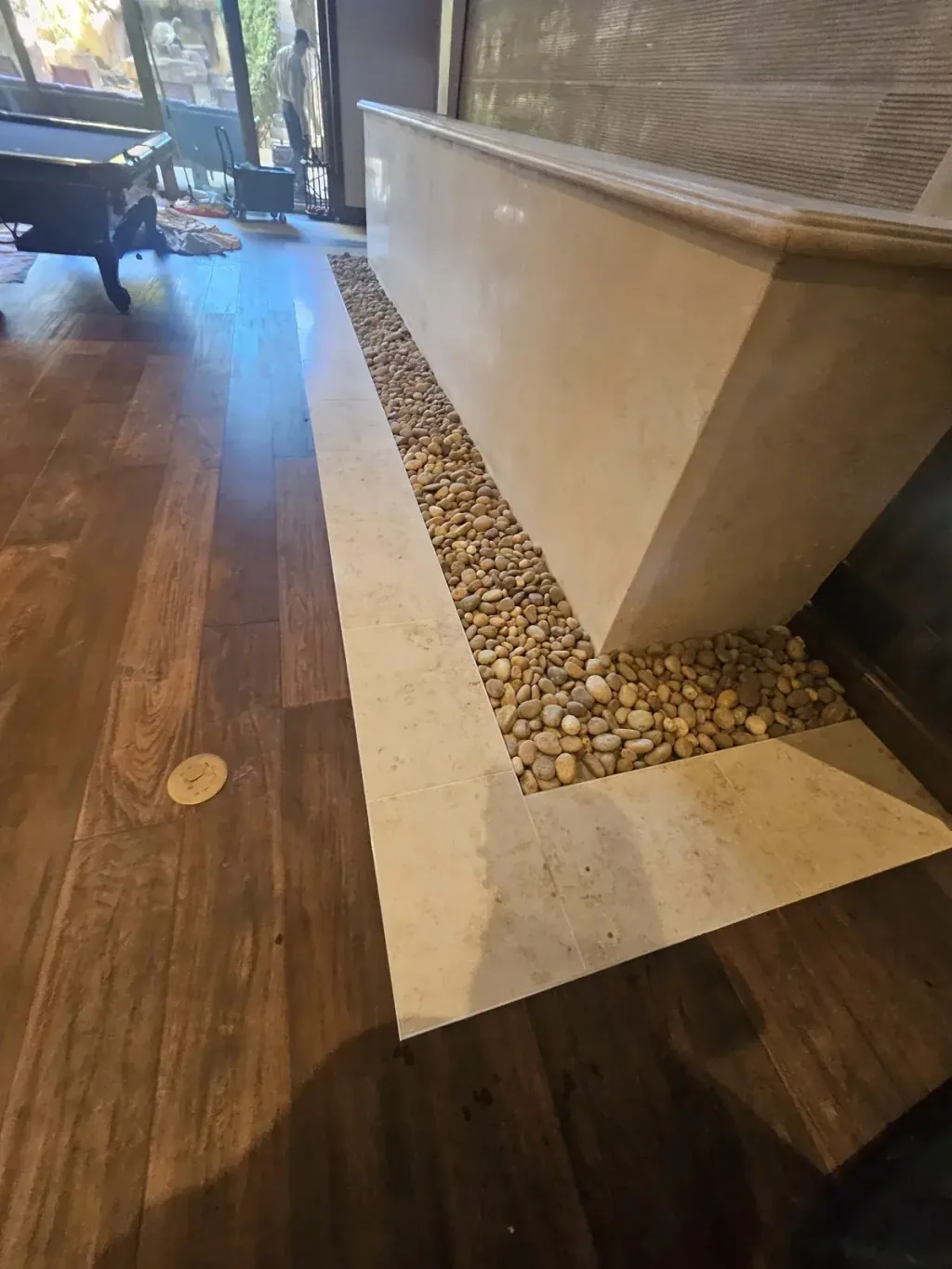
Before any repair, we sort what’s actually happening on your travertine into one of four categories:
- Residue or film, a haze or crust sitting on top of the stone, usually hard-water mineral film. It often wipes or scrapes off with the right method and needs no restoration, just proper cleaning.
- Stain, a substance has actually soaked into the pore structure. It looks darker than the surrounding stone, but the texture is unchanged and it feels smooth. This calls for identifying the stain chemistry and poultice extraction.
- Etch, a chemical reaction has altered the surface itself. It looks lighter, duller, or rougher than the surrounding stone and is visible under raking light. No poultice or cleaning product fixes an etch; it needs mechanical honing.
- Damage, physical loss of material: a chip, a crack, an open void, or missing filler. This needs repair or refilling, and if it’s near a sink, seam, or edge, the substrate underneath should be checked before any cosmetic fix.
The quick field test: darker and smooth to the touch usually means stain. Lighter, duller, or rough under raking light usually means etch.
How a professional diagnoses travertine
- Identify the actual material and finish, confirm it’s travertine, not a look-alike, and note whether it’s polished, honed, or filled versus unfilled.
- Document the symptom under raking light from several angles, does it darken when wet, follow a hole or vein, or start at a stress point like a sink or cooktop edge?
- Inspect the assembly, not just the surface, cabinet support and substrate condition, since a “new hole” is often a void opening from below and shouldn’t be filled until the cause is confirmed.
- Test conservatively, least-aggressive first, dry inspection, pH-neutral clean, rinse and dry, reinspect under raking light, then a small test spot before treatment.
Repair and restoration options
Filler pop-outs and voids are travertine’s bread-and-butter repair, and the sequence matters: remove loose or contaminated filler, clean and fully dry the cavity, then refill appropriately for the size of the hole, unsanded grout for small holes, sanded grout for voids an inch or larger, or epoxy or polyester resin where more durability is needed. The fill is leveled slightly proud, then honed flush and resealed. Etch marks are corrected the same way as marble: light etching often responds to a polishing powder worked in by hand, while moderate-to-severe etching needs a diamond hone or repolish, feathered well beyond the damaged spot to avoid a visible dip.
What may not be repairable
Deep structural cracks that run through the body of the slab, or extensive lippage from years of uneven wear across a large area, often go beyond spot repair and toward full resurfacing or, in severe cases, replacement of the affected section. If a void sits directly over unsupported substrate or a compromised cabinet, filling it cosmetically without addressing the support underneath is not a lasting fix.
Travertine and East Valley hard water
City of Phoenix water runs 172–302 ppm of hardness, or roughly 10–17.6 grains per gallon, per the city’s 2025 Water Quality Report. East Valley cities publish their own numbers, but they draw on the same Salt River Project and Colorado River supplies, and the water is hard across the valley. On its own that’s manageable, but the dry desert climate makes it harder on travertine: fast evaporation deposits minerals on the surface quickly and repeatedly, so a cleaned countertop can film over again within days. The trap is reaching for an acidic hard-water remover, it strips the film but etches the stone at the same time. Hard water on travertine needs pH-neutral, stone-safe products, applied more often than you’d expect, never a stronger acid.
Heat, sun, and monsoon considerations
The Phoenix metro sees well over 100 days a year at or above 100°F, and that heat plus intense, largely unfiltered sun accelerates sealer breakdown faster here than almost anywhere else, one reason indoor travertine commonly needs resealing every 12 to 18 months versus 3 to 5 years in a temperate climate. For outdoor travertine on a patio or pool deck, the Arizona monsoon (officially June 15 through September 30) brings the real risk: rapid saturation followed by fast drying drives efflorescence, where mineral salts carried up through the stone crystallize on the surface as it evaporates. The fix is a dry mop or vacuum, never a wet scrub, and if it recurs, finding and correcting the moisture source rather than cleaning the symptom.
Daily care and prevention
- Clean with a pH-neutral stone cleaner only, no vinegar, lemon, or “natural” acidic products, ever.
- Blot spills immediately rather than wiping them around.
- Dry standing water around faucets and sinks promptly.
- Use trivets, cutting boards, and coasters to prevent scratching a honed or polished finish.
- Inspect filled holes periodically for early signs of loosening filler.
- Reseal on a schedule closer to 12–18 months for East Valley interiors, sooner for sun-exposed or outdoor installations.
When to call a professional
Call a professional when you notice a new hole or void, a dull or rough patch that wasn’t there before, filler that’s visibly loose or crumbling, or a white crust on outdoor travertine that keeps returning after cleaning. Any of these can usually be corrected without replacing the stone, but the right fix depends on correctly identifying which of the four conditions, residue, stain, etch, or damage, you’re actually dealing with.
Common travertine questions
Why do new holes keep appearing in my travertine?
In almost every case, the stone isn't dissolving or falling apart. Travertine ships from the quarry either filled or unfilled, and even filled slabs keep micro-porosity beyond the holes you can see. Factory filler, grout, cement, or resin, loosens over time from foot traffic, vibration, moisture cycling, or from sitting over a pocket that was never fully packed. What looks like a brand-new hole is usually filler letting go or a hidden void finally being exposed. It's a maintenance issue, not a sign the countertop is failing.
Will sealing stop my travertine from etching?
No. Sealer sits in the pores of the stone and slows how fast liquid soaks in, which helps prevent staining. It does nothing to stop etching, because etching is a chemical reaction that happens right at the surface of the calcite crystals, above where any sealer sits. If acid touches unprotected calcium carbonate, it reacts regardless of how recently the stone was sealed.
Can I use vinegar or a hard-water cleaner like CLR on travertine?
No, and this is the single biggest trap for travertine owners here. Vinegar, lemon juice, and most CLR-type hard-water removers are acidic, and travertine reacts to acid exactly the way marble does. Using an acidic product to strip mineral film off travertine etches the stone at the same time it's cleaning it, you trade a hazy film for a permanently dulled patch. Hard water on travertine needs a stone-safe, pH-neutral approach, not a grocery-store acid cleaner.
Is a hole in my travertine the same thing as an etch mark?
No, and they need different fixes. A hole or missing chip is physical, filler is gone or stone has broken away, and it gets refilled. An etch mark is chemical, the polish or honed finish has been dissolved by acid, leaving a dull, rough, lighter patch with no material actually missing. Filling won't fix an etch, and honing won't fix a hole.
Is outdoor travertine around my pool or patio safe in the East Valley?
It can be, but it needs more attention than indoor travertine. Sun exposure, heat cycling, and monsoon-season moisture (the Arizona monsoon officially runs June 15 through September 30) all push harder on porous outdoor stone. A white, powdery crust on outdoor travertine is usually efflorescence, mineral salts carried up through the stone by moisture and left behind as it evaporates, and it needs a dry-mop and a fixed moisture source, not a wet scrub.
How often does travertine need to be resealed here?
More often than in humid climates. Trade practice in the Phoenix metro typically points to roughly every 12 to 18 months for indoor travertine, compared with 3 to 5 years in a temperate climate, because travertine's high porosity combined with fast desert evaporation pulls sealer breakdown and mineral deposit into a much shorter cycle. Treat that as a general guideline and confirm with a water-absorption test rather than a fixed calendar date.
Video responses from clients we've served across the East Valley.
Hear what our customers have to say once the work is finished. You can expect the same care and attention when you invite Stain Wranglers into your home or business.
Request an assessment.
Tell us about your surface and what you’re seeing. We’ll help you work out the next step for your home or commercial property.
- Stone, tile, floors and countertops
- Residential and commercial, San Tan Valley & the East Valley, AZ
- No charge to have us look at it
Having trouble with the form? Open it in a new tab.