
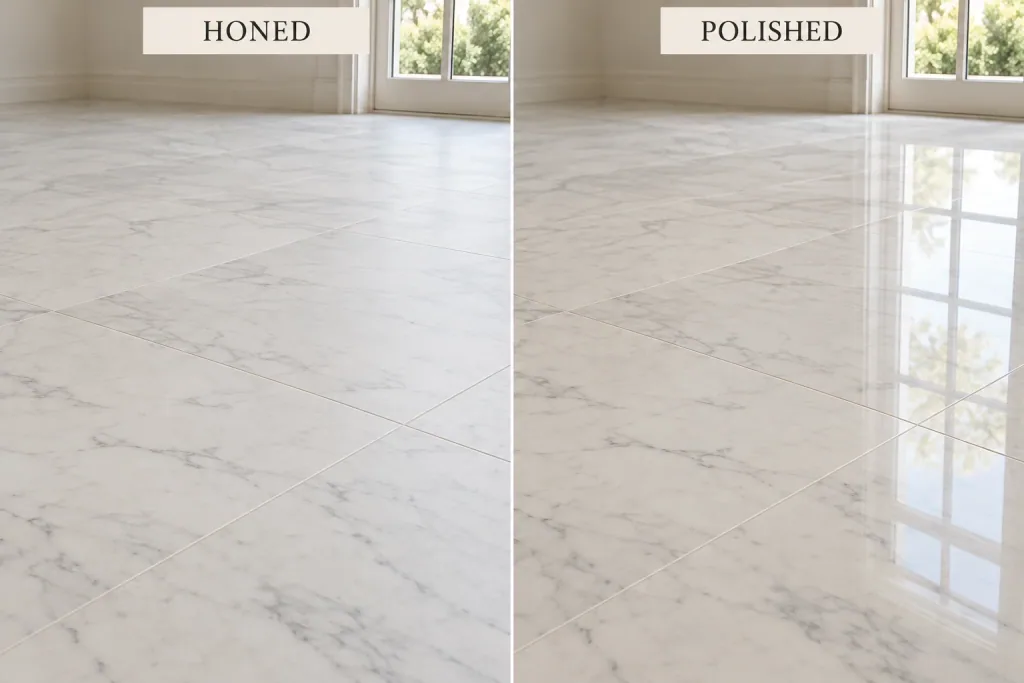
How the two finishes look in a room
Polished marble gives a clearer reflection of windows and lighting. Veining and color can appear more pronounced as the surface becomes more reflective. That can suit a room where the floor is a feature, but it also makes interruptions in the sheen easier to notice.
Honed marble has a matte or satin appearance rather than a mirror reflection. There is still natural variation in the stone; honing does not make the material one flat color. The exact sheen depends on the marble and the finish achieved, so “honed” is not one universal visual standard.
Ask to assess the intended finish in the room's own light. Look across it toward a window and from the main doorway. A sample viewed straight down can hide the reflections you will see every day.
What wear and etching look like on each finish
Fine wear often stands out on polished marble because it interrupts the reflection. On a honed floor, similar marks may be less conspicuous, but the stone has not become harder or resistant to acid. A spill can still change its texture and appearance.
Etching and staining also need to be kept separate. An etch changes the surface; a stain involves discoloration from material in the stone. Sealing may help reduce absorption, but it does not prevent acid from reacting with marble. The Natural Stone Institute's care guidance explains this acid sensitivity.
For a busy entry or kitchen, consider how much visible wear you are willing to maintain. A softer sheen can be a practical preference. It is not a promise that marks will disappear or that the floor will need no future work.
How maintenance differs
Both finishes benefit from regular grit removal, clean entry mats, prompt spill cleanup, and a compatible routine cleaner. The basic care does not reverse between honed and polished marble. What changes is how readily you see smears, traffic patterns, and altered gloss.
Do not use a shine-restoring product on a honed floor without checking what it will do to the finish. A topical treatment can create a patchy sheen that differs from the surrounding stone. Likewise, heavy scrubbing of one spot on a polished floor can leave a visible change in reflection.
For a floor that gets wet, discuss the use of the room and traction separately. A finish name alone does not establish slip resistance. Water, residue, footwear, and the actual surface condition all matter.
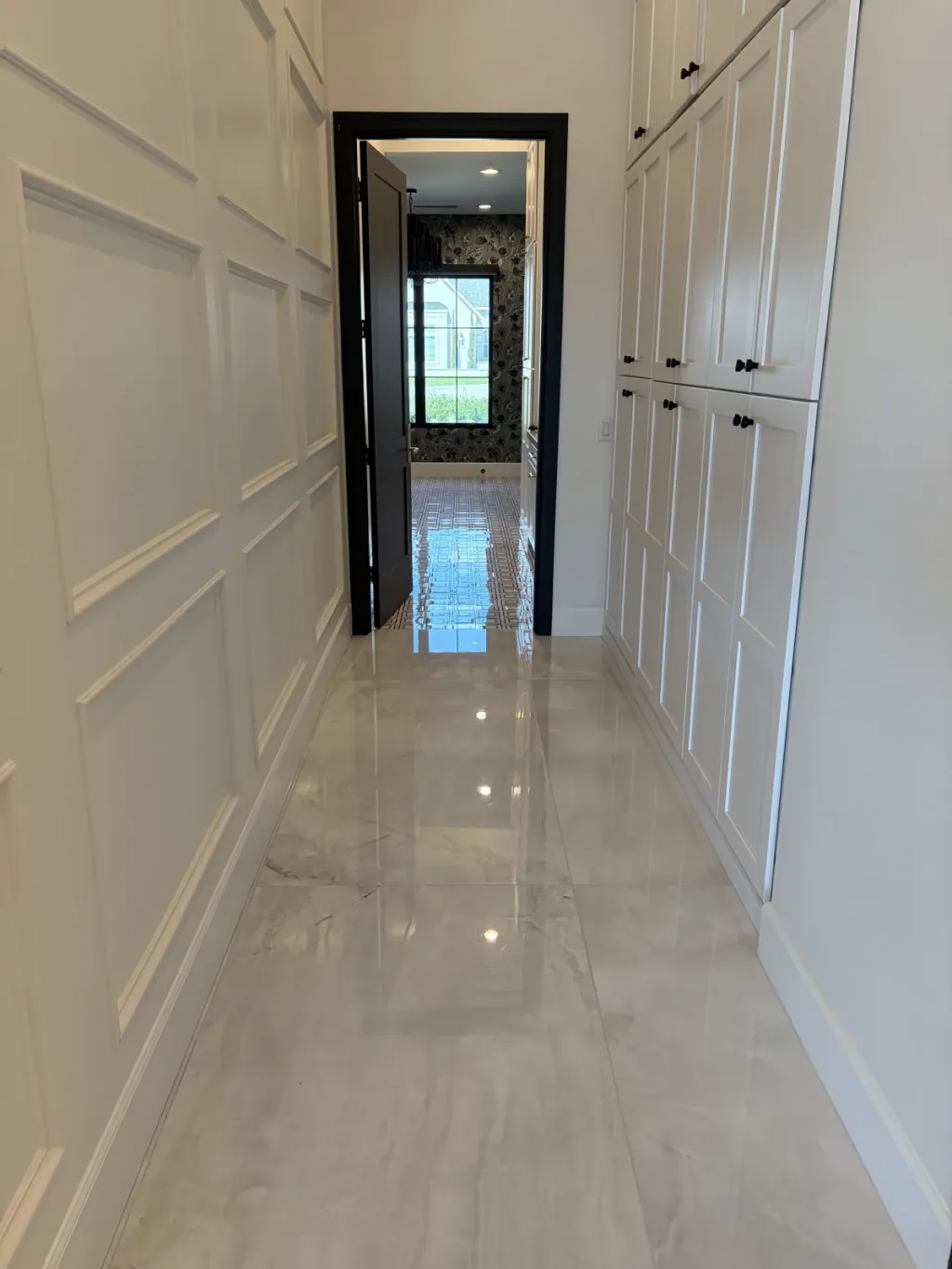
Can an existing marble floor change finish?
An existing marble floor can often be refinished to a different sheen if the stone and installation are suitable. The assessment needs to include previous coatings, repairs, tile edges, and the condition of the connected rooms. Changing just one patch can leave an obvious boundary. Our marble honing service takes a polished floor to an even honed finish with diamond abrasives, not a coating.
Honing and final polishing are stages with different purposes. Abrasive work establishes the surface and addresses suitable wear or damage. Further refinement and a compatible polishing compound can create the selected higher sheen. MB Stone's professional polishing instructions specify that the stone must be ready for polishing and may need diamond refinishing beforehand.
The amount of correction varies by floor. A particular powder or pad is not a substitute for testing the stone and checking the result at each stage.
What the finish choice changes in an estimate
The existing condition determines much of the work. Deep scratches, raised edges, coating removal, repairs, and restricted access can matter more than whether the final sheen is honed or polished. A room-wide finish change is also a different scope from maintaining an already even surface.
During the assessment, ask which repairs are included, where the work will stop, and how adjoining areas will look. Discuss the expected appearance before the abrasive sequence is chosen. We assess those factors rather than publishing one price that assumes every marble floor starts in the same condition.
Choose the finish for the way you use the room
If you enjoy strong reflections and are comfortable maintaining that appearance, a polished finish may suit you. If you prefer softer light and less emphasis on minor changes in sheen, consider a honed finish. Bring photos of finishes you like, but expect the same sheen to look different on your own marble.
Our marble floor restoration service starts by assessing the existing surface and discussing the finish you want. The aim is to agree on a result you understand before work begins.