
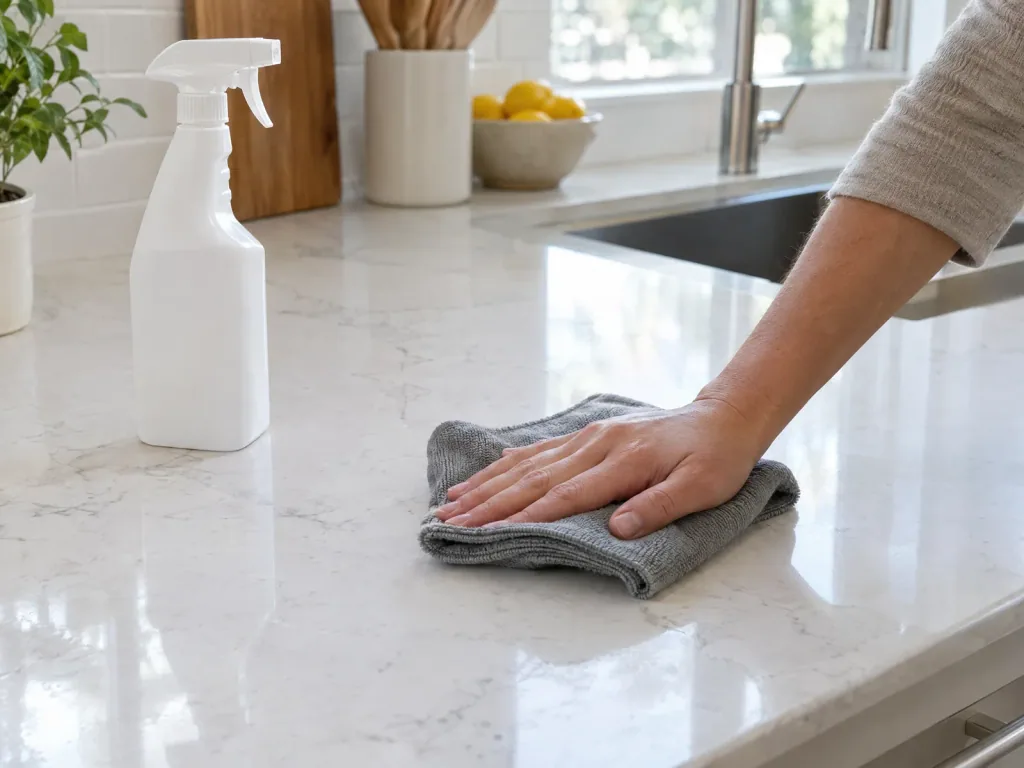
The everyday wipe-down
Most days, warm water and a damp microfiber cloth are all the stone needs. Microfiber lifts crumbs and grease without scratching, and it leaves less lint and fewer streaks than a sponge.
When the surface feels greasy or sticky, spray a pH-neutral cleaner labeled for natural stone, wipe, then go over it once with a cloth dampened in clean water. Finish with a dry cloth, paying attention to the area around the faucet and along the sink edge, where water sits longest. A drop of mild dish soap in warm water works too, as long as you rinse it off; soap left behind builds into a dull film.
What to keep off the stone
True quartzite shrugs off kitchen acids. The trouble is that many slabs sold under that name are dolomite or marble, and those etch. Until you know which you have, treat the counter as if it could.
- Vinegar, lemon and citrus cleaners. On a softer stone, they leave dull, lighter marks that no cleaner can remove.
- Abrasive powders, scouring pads and melamine sponges. They can scratch the finish and wear away the resin many slabs carry on the face.
- Steel wool. It leaves fine particles that rust into orange specks.
- Bleach and ammonia as everyday cleaners. They are harsher than the stone needs, and they break down sealer over time.
Hard-water scale at the faucet
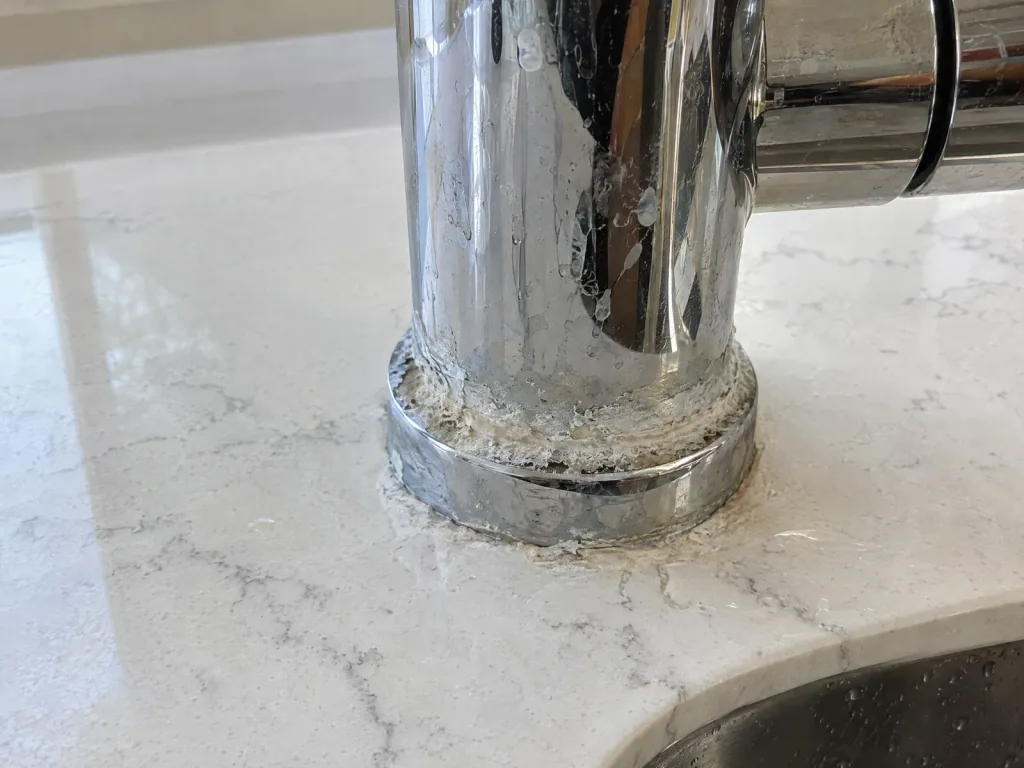
East Valley water is hard. Where it evaporates, at the faucet base and along the backsplash, it leaves a white crust. The usual fix for scale is an acid descaler, and that is exactly what not to use on a slab that might be dolomite or marble.
Instead, wet the scale with warm, soapy water and let it soften for a minute, then scrape it off with a fresh single-edge razor blade held nearly flat. Keep the surface wet as you go, and stop if the blade catches. A towel by the sink, and a quick dry after use, keeps the ring from coming back.
Oil and food spills near the cooktop
Cooking oil is the spill most likely to leave a mark, because it soaks in slowly and does not evaporate. Blot it up with a paper towel rather than wiping it across the stone, then wash the spot with warm, soapy water and dry it.
Wine, coffee and sauces are less of a worry on most quartzite, but clean them up the same day. A dark spot that stays after cleaning has soaked in, and scrubbing harder will not lift it. That needs stain removal, which draws the stain back out of the stone.
Check whether the stone is absorbing
A few times a year, put several drops of water on the top, near the sink and on an edge. Wipe them off after 10 to 15 minutes. If the stone underneath has darkened, it is soaking liquid in, and sealing will slow that down. If nothing changes, the slab is fine as it is.
When cleaning is not the answer
Some marks are in the stone, not on it. A dark band along the sink or a seam is liquid that wicked in from a raw edge. A dull patch in the work zone is worn finish. A dull ring where a lemon or glass of wine sat is an etch, and it means the slab is probably not true quartzite. None of these come out with a cleaner, and stronger products usually make them worse. Send us a photo of the whole counter and a close-up of the mark, and we will tell you what it is.