
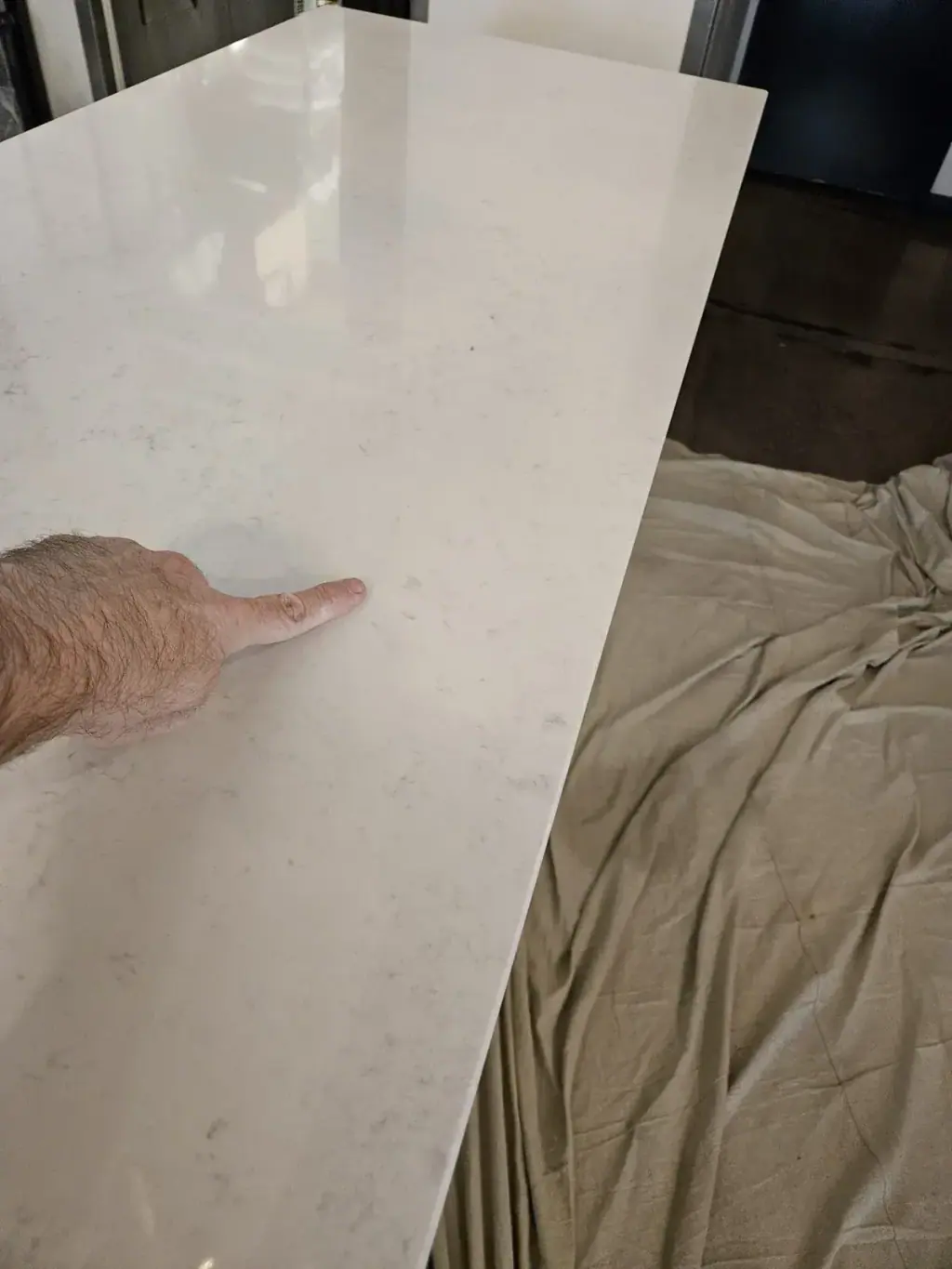
Does quartz need to be sealed?
The old answer was no. When quartz first came out, around 20 years ago, it really did hold up with little more than a wipe.
That is no longer what we see. We get a steady stream of calls from homeowners asking about quartz maintenance because their counters are staining. Some see discoloration that looks like it is inside the quartz, not on top of it.
We believe this comes down to quality. Not all quartz is the same. More brands, more factories and cheaper products have reached the market, and they do not all perform like the early slabs.
So yes, we recommend specific maintenance for quartz, including a sealer. A good sealer is invisible. It will not change the look, but it slows staining, and that matters most on white and light quartz, where every mark shows.
One check first: read your quartz warranty. Some brands have their own care rules, and it is worth knowing them before anything goes on the surface.
Does granite need to be sealed?
Most granite does. It is natural stone with tiny pores, and oil, wine and coffee can soak in.
How much depends on the slab. Some dense, dark granites barely absorb. Many lighter and speckled granites drink water fast. The color alone does not tell you, so test it (see below).
We handle this as part of granite countertop cleaning and sealing. A mark that has already soaked in needs stain removal first. Sealing over it locks it in.
Does quartzite need to be sealed?
Yes. Quartzite is hard, but hard is not the same as stain-proof. Many quartzites absorb oil and leave a dark spot.
Watch the sink and seams. Raw edges there soak up water and can show a dark halo. See our quartzite sealing service for how we treat it.
How often to seal granite, quartz and quartzite in Arizona
There is no universal calendar. Reseal when the stone starts absorbing again, not on a fixed date.
As a starting point, most Arizona kitchens we see need resealing every one to three years. Busy kitchens and light stone sit at the short end. The area around the sink and cooktop wears first.
The 15-minute water test
Put a few drops of water near the sink, in the main work area and on an edge. Wipe them off after 10 to 15 minutes.
- No dark spot: the sealer is still working.
- Dark spot that fades as it dries: the surface is absorbing. Time to reseal.
Water beading up is a good sign, but it does not prove the stone resists oil. Oil soaks in more slowly and stays.
When sealing won't fix it
Sealer prevents new stains. It does not remove old ones, fix etching, or restore a dull finish. Too much sealer left on the top also turns into a sticky haze.
Not sure what you are looking at? Text us a photo of the whole counter and a close-up. We will tell you if it needs sealing, cleaning or countertop restoration.