Travertine Floor Cleaning and Sealing in San Tan Valley and the East Valley

Travertine holds dirt in places a mop never reaches: open holes, worn filler, textured faces, and grout joints. Stain Wranglers cleans travertine floors in San Tan Valley and the East Valley with a method set for the stone, the filler, and whatever has already been applied to it.

If cleaning is not what the floor needs, we tell you that on the visit and explain what is. Our on-site estimates are free.

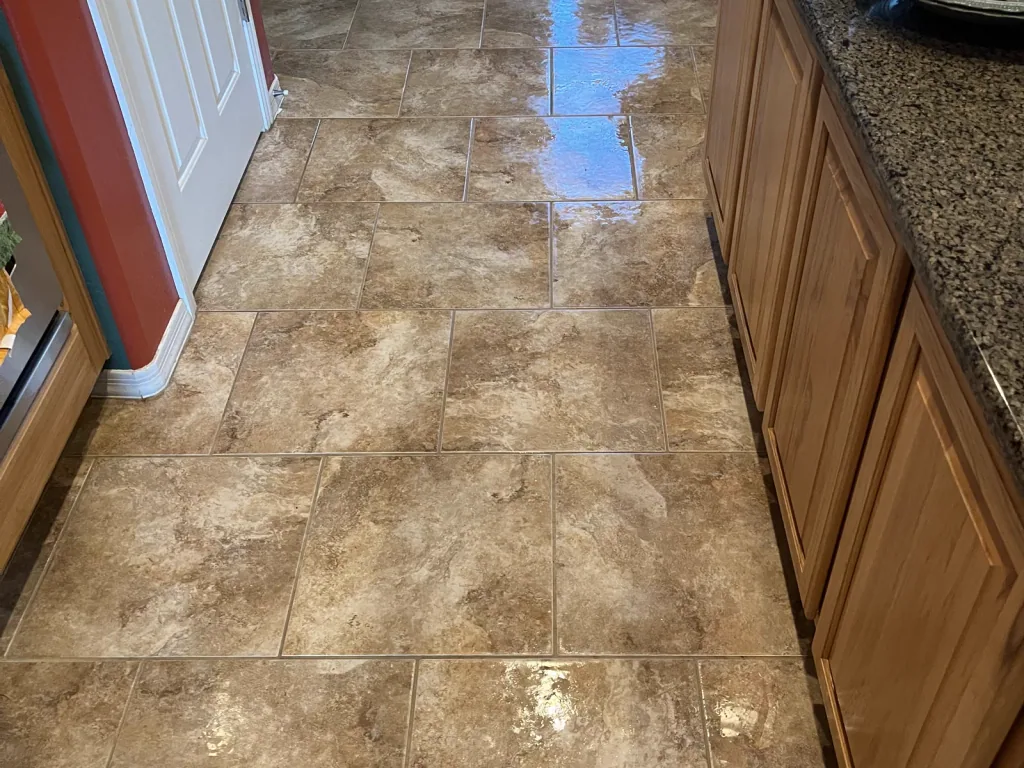
Travertine tile kitchen floor during professional cleaning, wet and reflecting the cabinetry
A travertine kitchen floor mid-clean, before rinsing and drying.

Google Reviews

More than 100 reviews with a five-star rating.

5.0100+ Google reviewsWrite a review
Tami EmmettVerified on Google
“Wonderful business. My counters and floors look awesome! Justin is professional and personable.”
Chelsey RaneyVerified on Google
“Wonderful service and the customer service is top notch! They got my floors spotless, which with 4 dogs is no easy task! Highly recommend!”
Tracey TomaszewskiVerified on Google
“AMAZING!!! Looks like I got brand new floors! Thank you. Would highly recommend”
Tiffany HarrisVerified on Google
“I highly recommend his floor cleaning services! He's reliable, professional, and does an excellent job. My floors looked amazing, and I couldn't be happier with the results.”
annette cressVerified on Google
“Stain Wranglers are honest, reliable and trustworthy. They have impeccable work ethic and will treat you fairly. Please give them a try.”
Richard ChurchVerified on Google
“Outstanding customer service! So refreshing to use a company that carries very high standards. Stain Wranglers exceeded our expectations. A+”
TravisVerified on Google
“Highly recommend! On time, great service, and very professional. Very meticulous in their work.”
Johnny AldacoVerified on Google
“When you meet someone, with character you know!! This is what my first impression was of Stain Wranglers, will use them over and over and spread the word to everyone. Thank you”
keaton angevineVerified on Google
“Justin was quick to show up and get the job scheduled. He worked hard to get our home clean and followed up after he was done to make sure we were happy. Customer service at its finest! Highly recommended”
Teresa WrightVerified on Google
“Justin is super friendly and explains everything thoroughly. Def would recommend!”

Why travertine is harder to clean than tile

Travertine is a limestone that forms around mineral springs. As it forms, gas and plant matter leave holes through the stone. Factory-finished tile is either filled, with cement, resin, or epoxy pressed into those holes and ground flush, or left unfilled for a rustic, open texture. Tumbled travertine adds rounded edges and a rougher face on top of that.

Every one of those openings is a place for soil to settle. Over years of foot traffic, filler shrinks, cracks, and crumbles out, and the new pits fill with dark grime that stands out against the lighter stone. Grout joints between tumbled or chiseled-edge tiles are wider and deeper than on porcelain, so they hold more soil too.

The stone is also mostly calcium carbonate. Vinegar, citrus, and acidic hard-water removers react with it and leave dull, rough marks called etches. That rules out much of the chemistry that works on porcelain, and it is why the method starts with identifying the stone and the filler rather than reaching for the strongest cleaner.

Travertine is one of several stones we clean. For marble, limestone, Saltillo, slate, and flagstone, see our stone tile cleaning overview.

Cut direction changes the look but not the care. Vein-cut travertine is sliced along its layers and shows long, parallel bands. Cross-cut (fleuri) travertine is sliced across them and shows a cloudy, rounded pattern. Both have holes, and both are cleaned with the same caution around the fill.
Dirty, etched, worn, or open?

Five common travertine problems look similar from across the room. Only the first one is a cleaning job.

Soil and residue

Looks like: grey or dark film, black specks in the holes, darker grout, a sticky or smeared feel.
Common cause: traffic, dirty mop water, too much cleaner.
Fix: professional cleaning, covered on this page.

Etching

Looks like: dull, slightly rough patches that look lighter under angled light and stay dull when dry.
Common cause: acidic spills or cleaners.
Fix: honing and polishing. See travertine restoration and polishing.

Worn finish

Looks like: dull traffic lanes, scratches, uneven shine between rooms.
Common cause: grit under shoes and furniture over years.
Fix: diamond honing and polishing.

Open or loose filler

Looks like: pits and holes that catch the mop, crumbled material around them.
Common cause: filler shrinking and breaking down under traffic.
Fix: small openings refilled after cleaning; widespread failure refilled as part of restoration.

Cracked or hollow tiles

Looks like: a crack running across one or more tiles, a tile that rocks or sounds hollow when tapped.
Common cause: the tile has lost its bond to the floor below, or a crack in the slab has carried through.
Fix: remove and replace the tile, covered below.

How we clean travertine floors

  1. Identify the stone, the fill, and what is on it

    We check whether the travertine is filled or unfilled, honed, polished, or tumbled, how sound the filler is, and whether a wax, coating, or old sealer is on the surface. Cabinets, wood transitions, and adjoining rooms are protected before any water goes down.

  2. Remove dry soil and test the chemistry

    Loose grit comes off first. A test area confirms the cleaner lifts the soil without changing the finish. Products are chosen for calcium-based stone, never an acidic descaler.

  3. Work soil out of the holes and joints

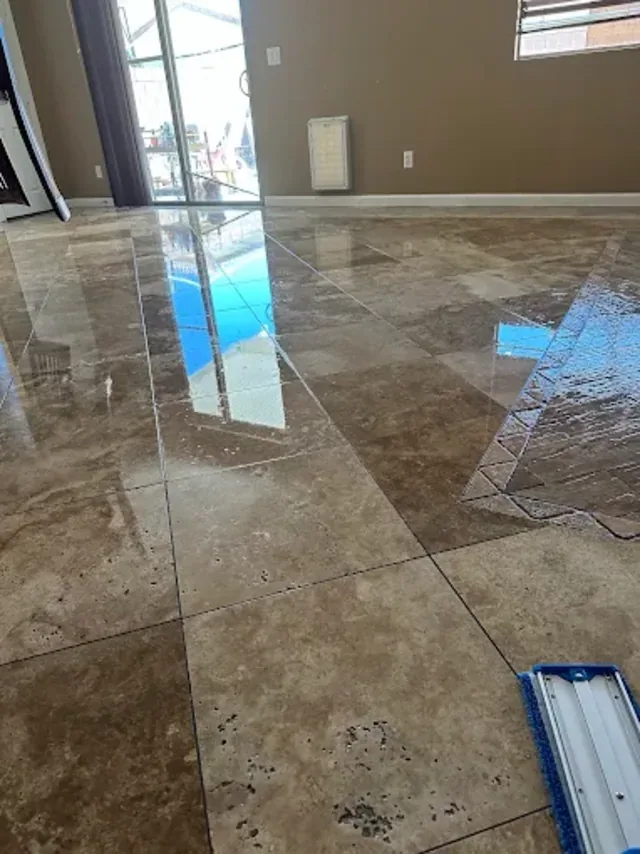
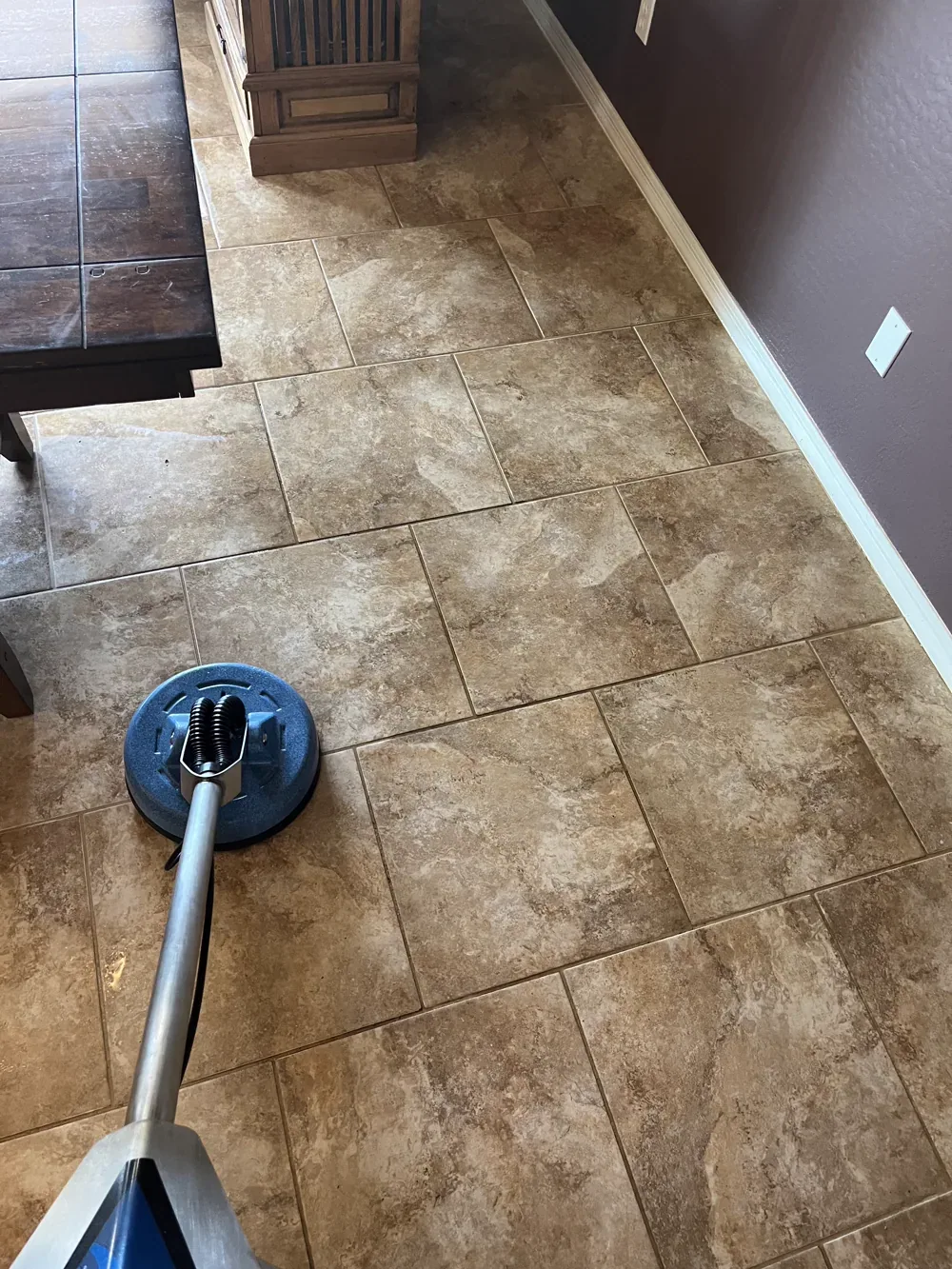
    Agitation loosens soil packed into the texture and grout, and rotary extraction recovers the dirty solution instead of leaving it to dry back into the floor. Pressure and dwell time are set for the stone and eased off around weak filler.

  4. Rinse, dry, and inspect

    We look at the floor dry, not wet, because a wet floor can hide film and dull spots. Anything cleaning did not correct is pointed out and explained.

  5. Refill small openings and seal where it helps

    Small holes exposed by cleaning can be refilled with a color-matched filler. After the floor dries, we test how quickly it absorbs water and recommend sealing only if it will make a difference.

Holes, popped filler, and what happens to them

When filler has been failing for a while, the soil packed into the pits is often the only thing holding loose pieces in place. Cleaning removes that soil, so we check the fill first and tell you what to expect before we start.

A handful of open holes can be cleaned out and refilled with a color-matched filler on the same visit. When failure is spread across the floor, refilling hole by hole does not hold up. The lasting fix is to fill the floor as part of a restoration, so the new fill and the surrounding stone are honed flush together. That process, along with leveling raised tile edges, is covered on our travertine restoration and polishing page.

Furniture can open new holes too. In a Pecan Creek South home where bar stool legs kept punching holes in the travertine, we cleaned out the old holes, filled them and honed the floor to a matte finish.

Technician working an extraction tool across a travertine tile floor

Cracked and hollow tiles are a repair, not a cleaning

A crack that runs across a tile, or a tile that sounds hollow when you tap it, is a problem with the bond underneath, not with the surface. No cleaner or sealer will close it. Cracks also collect soil, so they tend to get more noticeable after a floor is cleaned, not less.

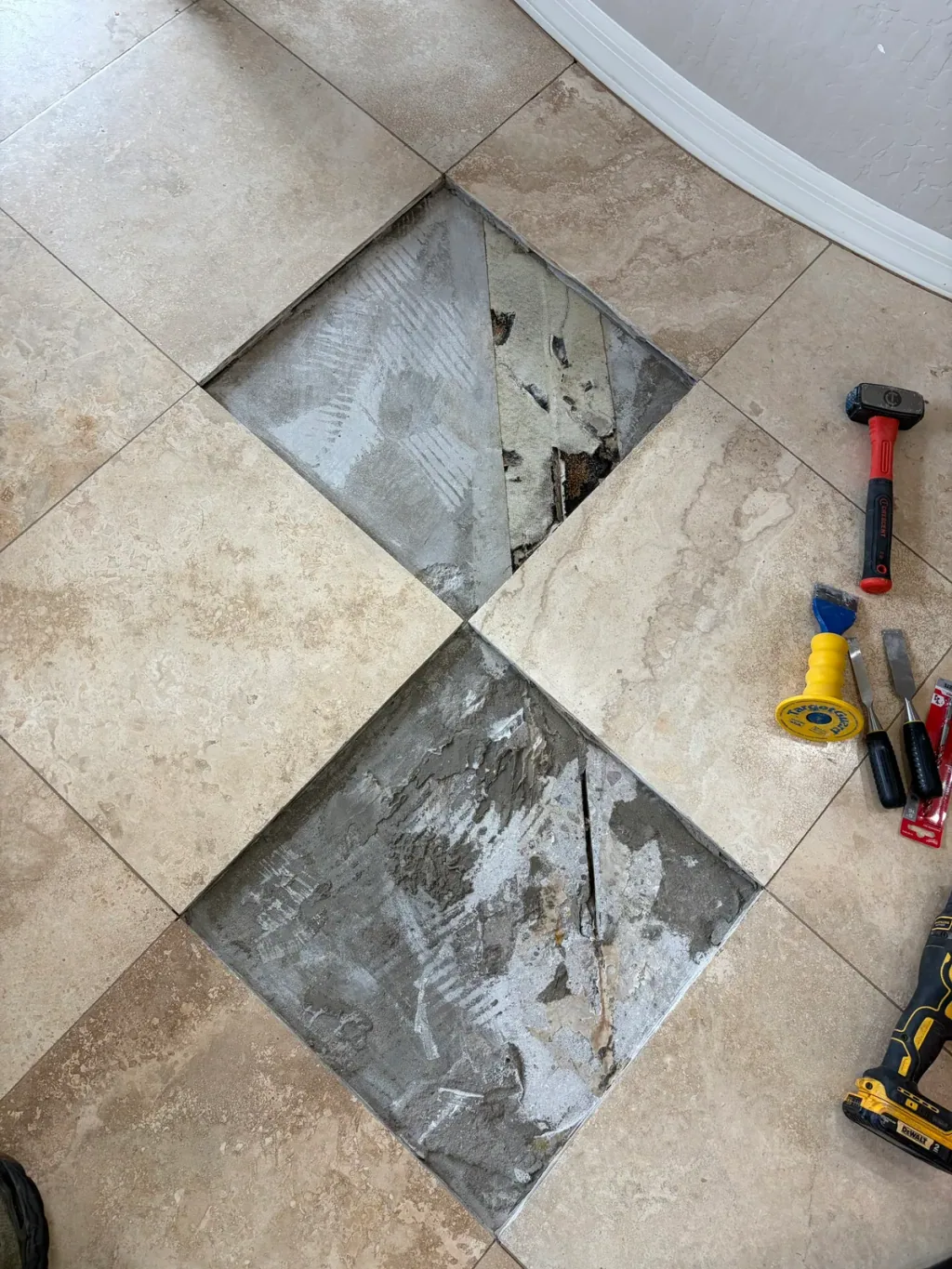
We cut out the damaged tiles without disturbing the ones around them, clean the setting bed down to a sound surface, and set replacement stone in fresh thinset. Once it has cured, the joints are grouted and the new tile is cleaned, and honed if needed, so it sits flush and matches the floor around it. If you kept spare tiles from the original install, tell us. Stone from the same lot is the easiest match.

When the crack follows a line through the slab, we tell you that too. A new tile over an active slab crack can crack again, so we talk through what is underneath before setting new stone.

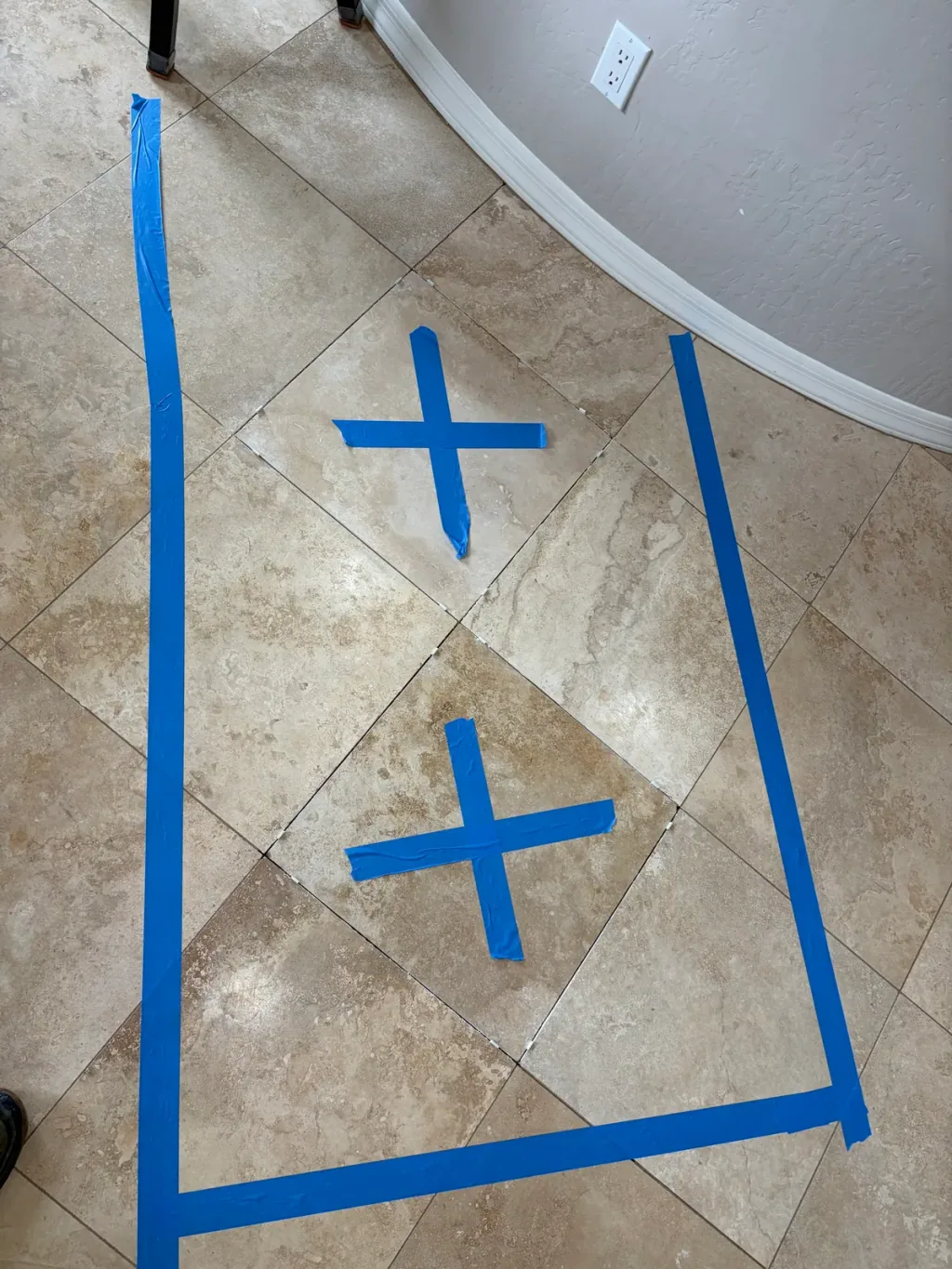
Blue tape marking two cracked travertine tiles for replacement on a diagonal floor
Cracked tiles marked out before anything is removed.
Two cracked travertine tiles removed from a diagonal floor, exposing the thinset bed and a mesh membrane below
Cracked tiles cut out, down to the setting bed and membrane.
Travertine tiles lifted with suction cups during a replacement, with an air mover drying the floor in front
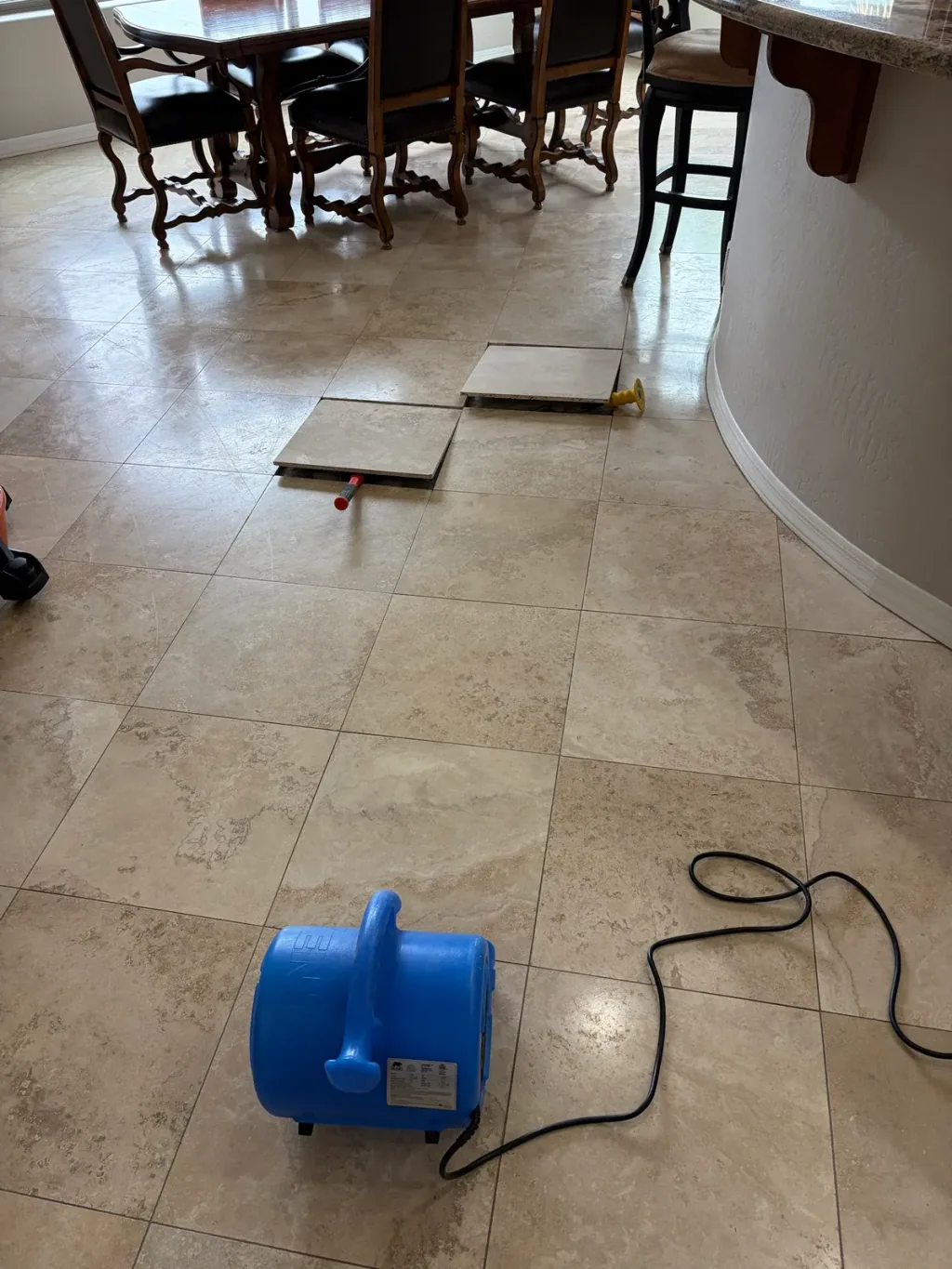
Tiles lifted for replacement while the rest of the floor stays in use.

Sealing travertine, and removing the wrong coatings

A penetrating (impregnating) sealer soaks into the stone and slows how fast water, oil, and soil get in. It does not form a film, it does not change the sheen, and it lets moisture in the stone escape. For most indoor travertine, this is the sealer to consider.

A color-enhancing sealer also penetrates, but it darkens and deepens the color, similar to how the stone looks wet. It is a look some homeowners want and others do not, so we test it on a small area first.

Wax and topical coatings sit on top of the stone. On travertine they tend to scuff, yellow, peel in traffic lanes, and trap soil underneath. If your floor has one that is failing, it has to be stripped before the stone can be cleaned or judged properly. We tell you when we find one and include removal in the scope.

Sealing is not a fix for dullness. A sealer will not polish out etches or wear, and adding coats to make a floor shiny usually causes the coating problems above.

Outdoor travertine: pool decks, patios, and coping

Outdoor travertine in the East Valley is usually tumbled and unfilled, and it lives with pool water, irrigation overspray, full sun, and big temperature swings. That changes what shows up on it.

White crust and powder are usually mineral deposits from hard water and pool splash, or efflorescence: salts carried up through the stone by moisture and left behind as it evaporates. Washing it off works only for a while if the moisture keeps carrying more salt to the surface.

Flaking and pitting on the face of the stone can come from salt damage. When salty water soaks in and then dries quickly in desert heat, salt crystals grow inside the pores, and that growth can push small pieces of the surface off over time. Pool water and irrigation are common sources. Repeated flushing and a breathable outdoor sealer that slows water getting in help slow it down, but stone that has already spalled has lost material and needs repair or replacement.

Heat also matters. Coping and pavers expand and contract through the seasons, which can open joints and hairline cracks that let more water in.

For the full outdoor process, see our pool deck resurfacing and paver cleaning and sealing pages.

Get an estimate for your travertine

Send a photo of the whole room and a close-up of the holes, grout, or dull area that bothers you. Light from the side makes pits and dull spots easier to see. Include your city, a rough square footage, and the names of any cleaners, sealers, or coatings that have been used on the floor.

We assess the soil, the filler, any old treatments, and whether anything beyond cleaning is involved before confirming the scope. For routine care between visits, see how to clean travertine floors.

See the work

See a travertine cleaning and filling project

About 900 square feet of downstairs travertine in Pecan Creek South, San Tan Valley: deep cleaned, holes filled and honed to matte.

Travertine floor cleaning questions

Why does my travertine still look dirty after I mop it?

Travertine is full of small holes and pores, and many floors have filler that has cracked or worked loose. Soil packs into those openings and into the grout joints, where a mop only spreads it around. Dirty mop water and leftover cleaner film make it worse. A professional cleaning pulls that soil out of the texture rather than pushing it deeper.

Will professional cleaning knock out the filler in my travertine?

Filler that is sound should stay in place. Filler that is already cracked or loose may come out during cleaning, because the soil was holding it in. We check the fill before we start, adjust the method around weak areas, and tell you what we found. Small openings can be refilled on the same visit; widespread failure is a restoration job.

Can you get rid of the dull spots on my travertine with cleaning?

Only if the dull spot is residue or soil. If acid from a spill or cleaner has etched the stone, or traffic has worn the finish down, the surface itself has changed. That needs honing and polishing, which is covered on our travertine restoration and polishing page.

Should travertine be sealed after it is cleaned?

Often, but not always. A penetrating sealer reduces how fast spills and soil soak into the stone without forming a film on top. Whether your floor needs it depends on how absorbent it is, what was applied before, and where it is in the house. We test absorption after cleaning and explain the options, including color-enhancing sealers.

Do you clean outdoor travertine pool decks and patios?

Yes. Outdoor travertine deals with pool water, irrigation overspray, sun, and heat, so the cleaning and the sealer are chosen differently from an indoor floor. White crust, flaking, and pitting all point to different causes, and we identify which one you have before treating it.

How much does travertine floor cleaning cost?

It depends on the square footage, how much soil is in the holes and joints, the condition of the filler, any old coatings, and whether sealing is part of the job. We give a free on-site estimate and explain the scope before any work starts.

Do you clean travertine in my part of the East Valley?

We are based in San Tan Valley and serve Queen Creek, Gilbert, Mesa, Chandler, Tempe, Apache Junction, Ahwatukee, and Scottsdale. Send your city and a few photos of the floor so we can talk through the visit.

Hear directly from our customers

Real customers describing their experience with Stain Wranglers after the work was finished.

A customer shares her experience with Stain Wranglers.
A local restaurant owner after a commercial floor-cleaning job.

Request an assessment.

Tell us about your surface and what you’re seeing. We’ll help you work out the next step for your home or commercial property.

  • Stone, tile, floors and countertops
  • Residential and commercial, San Tan Valley & the East Valley, AZ
  • No charge to have us look at it

Having trouble with the form? Open it in a new tab.